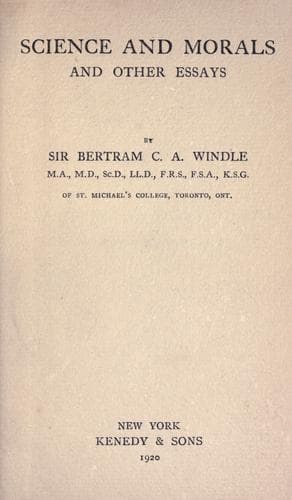
Science and Morals and Other EssaysWindle, Bertram Coghill Alan, Sir
Religion
Science and Morals and Other Essays
Windle, Bertram Coghill Alan, Sir
Essays; Religion and science; Science
That evolution may occur within a class seems to be quite certain. The
case of the Porto Santo rabbits, one of many cited by Darwin or brought
to knowledge since his time, will make clear what is meant. Porto Santo
is a small island, not far from Madeira, on which a Portuguese
navigator, named Zarco, let loose, somewhere about the year 1420, a doe
and a recently born litter of rabbits, which we may feel quite sure
belonged to one of those domestic breeds which have all been derived
from the wild rabbit of Europe known to zoologists as _Lepus Cuniculus_.
The island was a favourable spot for the rabbits, for there do not
appear to have been any carnivorous beasts or birds to harry them, nor
were there other land mammals competing with them for food; and, as a
result, we are told that they had so far increased and multiplied in
forty years as to be described as "innumerable." In four and a half
centuries these rabbits had become so different from any European
rabbits that Haeckel described them as a species apart, and named it
_Lepus Huxlei_. This rabbit is much smaller than the European form,
being described as more like a large rat than a rabbit. Its colour is
very different from its European relatives; it has curious nocturnal
habits; it is exceedingly wild and untamable. Most remarkable of all,
and most conclusive as to specific difference, Mr. Bartlett, the highly
skilled head keeper of the London Zoological Gardens, utterly failed to
induce the two males which were brought over to those gardens to
associate with or to breed with the females of various other breeds of
rabbits which were repeatedly placed with them. If the history of these
Porto Santo rabbits had been unknown to us, instead of being a matter as
to which there can be no doubt, every naturalist would at once have
accepted them as a separate species. We need not hesitate, it appears,
to do so and to admit that it is a new species which has been produced
within historic times and under conditions with which we are fully
acquainted. It may, however, be argued, and quite fairly argued, that
such a process of evolution, though definitely proved, is a very
different thing from such an evolution as would permit of a common
ancestry for animals so far apart, for example, as a whale and a rabbit,
or perhaps even nearer in relationship, as between a lion and a seal. To
discuss this further would require a dissertation on the highly involved
question of species and varieties, and that is not now to be attempted.
What, however, may be said is that the difficulties presented by what is
called phylogeny--that is, the relationships of different classes to one
another--are so great as to have led more than one man of science to
proclaim his belief that evolution has been poly--and not
mono--phyletic. Such is the view which has been enunciated by Father
Wasmann, S.J., whose authority on a point of this kind is paramount. It
has also been upheld by Professor Bateson, a man widely separated from
Public-domain text, read in full here on John Shaqi.
Reviews
Reviews
No reviews yet
Be the first to share your thoughts on this work.
Elsewhere in the archive
Join the Discussion
Join the discussion
Sign in to leave a comment or review.
Sign InorCreate an account