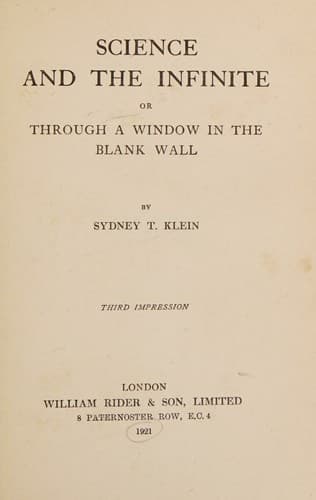
Science and the Infinite; or, Through a Window in the Blank WallKlein, Sydney T. (Sydney Turner)
Religion
Science and the Infinite; or, Through a Window in the Blank Wall
Klein, Sydney T. (Sydney Turner)
Religion and science
Let us now look forward along the path we are to take. We are standing
on the outermost part of our Solar System, and there is no other
planet towards which we can wing our flight; but all around are
multitudes of stars, some shining with a brightness almost equal to
what our Sun appears to give forth at that great distance, others
hardly visible, but the smallest telescope increases their number
enormously, and presents to our mind the appalling phantom of
_immensity_ in all its terror, standing there to withstand our next
great step. How are we to continue on our journey when our very senses
seem paralysed by this obstruction, and even imagination is powerless
from utter loneliness? One guide only is there to help us, the
messenger which flits from star to star, universe to universe; Light
it is which will help us to appreciate even these bottomless depths.
Now, Light travels 186,000 miles per second, or 12 million miles every
minute of time. It therefore takes only about four hours to traverse
the huge distance between our Sun and Neptune, where we are now
supposed to be standing; but to leap across the space separating us
from the nearest star, it would require many years for Light,
travelling at 186,000 miles every second of that time, to span the
distance. There are, in fact, only fifteen stars in the whole heaven
that could be reached, on the wings of Light, in sixteen years!
Let us use this to continue our voyage. On a clear night the human eye
can perceive thousands of stars, in all directions, scattered without
any apparent order or design; but in one locality, forming a huge ring
round the heavens, there is a misty zone called the Milky Way. Let us
turn a telescope with a low aperture on this, and what a sight
presents itself! Instead of mist, myriads of stars are now seen
surrounded by nebulous haze. We put a higher aperture on, and thus
pierce further and further into space; the haze is resolved into
myriads more stars, and more haze comes up from the deep beyond,
showing that the visual ray was not yet strong enough to fathom the
mighty distance; but let the full aperture be applied and mark the
result. Mist and haze have disappeared; the telescope has pierced
right through the stupendous distance, and only the vast abyss of
space, boundless and unfathomable, is seen beyond.
Public-domain text, read in full here on John Shaqi.
Reviews
Reviews
No reviews yet
Be the first to share your thoughts on this work.
Elsewhere in the archive
Join the Discussion
Join the discussion
Sign in to leave a comment or review.
Sign InorCreate an account