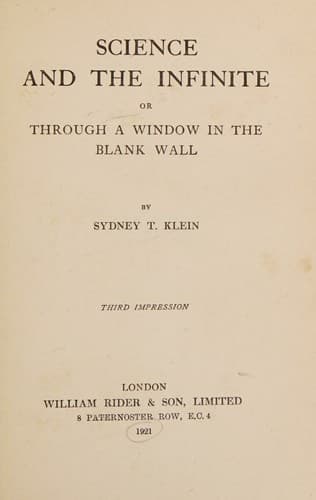
Science and the Infinite; or, Through a Window in the Blank WallKlein, Sydney T. (Sydney Turner)
Religion
Science and the Infinite; or, Through a Window in the Blank Wall
Klein, Sydney T. (Sydney Turner)
Religion and science
Let us take now the utmost limit of telescopic power in all
directions. Where are we after all but in the centre of a sphere whose
circumference is 100,000 times as far from us as one of the nearest
fixed stars, a distance that light would take over a million years to
traverse, and beyond whose circuit, infinity, boundless infinity,
still stretches unfathomed as ever? We have made a step, indeed, but
perhaps only towards acquaintance with a new order of infinitesimals.
Once the distances of our Solar System seemed almost infinite
quantities; compare them with the intervals between the fixed stars,
and they become no quantities at all. And now when the spaces between
the stars are contrasted with the gulfs of dark spaces separating
firmaments, they absolutely vanish away. Can the whole firmamental
creation in its turn be nothing but a corner of some mightier scheme?
But let us not go on to bewilderment: we have passed from planet to
planet, star to star, universe to universe, and still infinite space
extends for ever beyond our grasp. We have gone as far towards the
infinite as our sight, aided by the most powerful telescope, can hope
to go. Is there no way then by which we can continue our journey
further towards the appreciation of this infinity? A few years ago we
should probably have denied that it was possible for man to go
further; but quite lately a new method of observation has been
developed, and we will try and use this to continue our flight.
The reason why, to our sight, an object becomes apparently smaller and
smaller as it is withdrawn from the eye, until it at last disappears
entirely, is that the eye is a very imperfect instrument for viewing
objects at a great distance; it can only form an image of an object
when that object is near enough to subtend a certain angle, or, in
popular language, to show itself a certain size--the rays of light
must converge--in fact, the eye cannot single out and appreciate
parallel rays: could it do this, objects would not appear to grow
smaller as they are removed. A pencil might be removed to the Moon,
240,000 miles away, and would still appear to the eye the same size as
it does here close to you; with perfect vision there would be no such
thing as perspective, but, with our present conditions of sight, the
result would be inconvenient. We should never be able to see, at one
and the same time, anything larger than the pupil of our eye. The
beauties of the landscape would be gone, and our dearest friends would
pass us unheeded and unseen; everyday life would resolve itself into a
task similar to that of attempting to read our newspaper every morning
by means of a powerful microscope; we should commence by getting on to
a big black blotch, and, after wandering about for half an hour, we
might perhaps then begin to find out that we were looking at the
little letter "e," but anything like reading would be quite out of the
question. We may, therefore, with our limited aperture of sight, be
Public-domain text, read in full here on John Shaqi.
Reviews
Reviews
No reviews yet
Be the first to share your thoughts on this work.
Elsewhere in the archive
Join the Discussion
Join the discussion
Sign in to leave a comment or review.
Sign InorCreate an account