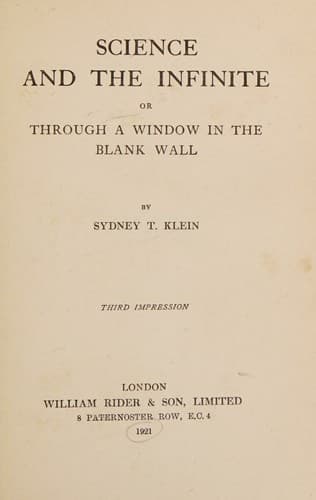
Science and the Infinite; or, Through a Window in the Blank WallKlein, Sydney T. (Sydney Turner)
Religion
Science and the Infinite; or, Through a Window in the Blank Wall
Klein, Sydney T. (Sydney Turner)
Religion and science
As conceptional knowledge is based on perceptional knowledge, and we
can only perceive about six times per second, and as the principal
forms of knowledge are gained through the eye, we are conceiving
progress in phenomena under a very restricted outlook; we cannot
recognise such slow motions as, for instance, the hour-hand of a
watch, the growth of a tree, or rise of the tide, except by noting the
change that has occurred after a long interval; there is therefore a
whole world of events which we cannot see. Owing to this limit, in our
unit of time perception, we also cannot perceive events which are
taking place beyond a certain quickness, they become blurred and give
the impression of continuity, and constitute another world of events
lost to us. For the same reason there is a whole world of sensation
lost to us by our limited unit of sound perception; we cannot follow
separate sound-events if they occur quicker than sixteen in a second,
beyond that they become blurred and give the impression of continuity.
If, on the other hand, our units of perception were increased a
thousandfold, as is probably the case with some insects, our conscious
lives would contain a thousand more events than they do at present,
and, as the consciousness of length of life is dependent upon the
number of events that have been perceived, we should under these
conditions have passed on this earth a life equivalent to, say, 70,000
years under our present restricted unit; every second of that long
period would have been as full of events for us as is a second in our
present life of seventy years. If, on the other hand, our unit of
perception were decreased a thousandfold, our length of life, based
upon perception of events, would be no longer than 25-1/2 of our
present days; if our life were actually reduced to that period (so as
to regain our present units of perception) we should be old and
grey-headed before the sun had risen for the twenty-fifth time since
our birth. If our unit of perception, with our length of life, were
again reduced a thousandfold, the whole of our life of seventy years
would now only be equal to forty-three minutes, and, in the whole of
that life, we could only see the sun move ten degrees, namely, twenty
of its own diameters in the heaven; if we were born, say, at noon on
midsummer's day, we could never have any idea of anything but daytime,
and neither our fathers, nor grandfathers, nor great-grandfathers for
fifteen generations before them could have seen the sun rise; but
there would have been a tradition, handed down from a far distant past
generation, that a long time ago, beyond the memory of man, there was
no sun at all, everything was pitch dark, and that time was called the
"Great Shadow." If their records could have gone still further back
for the same length of time they would have heard that, before the
"Great Shadow," the sun was always shining in the heavens, and that
Public-domain text, read in full here on John Shaqi.
Reviews
Reviews
No reviews yet
Be the first to share your thoughts on this work.
Elsewhere in the archive
Join the Discussion
Join the discussion
Sign in to leave a comment or review.
Sign InorCreate an account