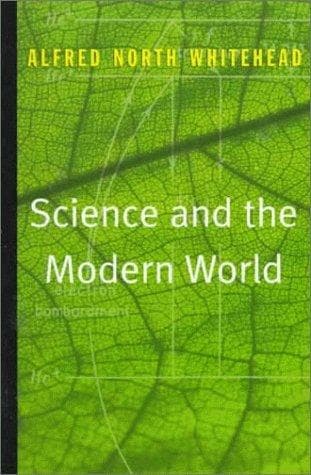
Science and the modern worldWhitehead, Alfred North
Religion
Science and the modern world
Whitehead, Alfred North
Science
The conclusion is either that the earth is always stationary in the
ether, or that there is something wrong with the fundamental principles
on which the interpretation of the experiment relies. It is obvious
that, in this experiment, we are very far away from the thoughts and the
games of the children of King Minos. The ideas of an ether, of waves in
it, of interference, of the motion of the earth through the ether, and
of Michelson’s interferometer, are remote from ordinary experience. But
remote as they are, they are simple and obvious compared to the accepted
explanation of the nugatory result of the experiment.
The ground of the explanation is that the ideas of space and of time
employed in science are too simple-minded, and must be modified. This
conclusion is a direct challenge to common sense, because the earlier
science had only refined upon the ordinary notions of ordinary people.
Such a radical reorganization of ideas would not have been adopted,
unless it had also been supported by many other observations which we
need not enter upon. Some form of the relativity theory seems to be the
simplest way of explaining a large number of facts which otherwise would
each require some _ad hoc_ explanation. The theory, therefore, does not
merely depend upon the experiments which led to its origination.
The central point of the explanation is that every instrument, such as
Michelson’s apparatus as used in the experiment, necessarily records the
velocity of light as having one and the same definite speed relatively
to it. I mean that an interferometer in a comet and an interferometer on
the earth would necessarily bring out the velocity of light, relatively
to themselves, as at the same value. This is an obvious paradox, since
the light moves with a definite velocity through the ether. Accordingly
two bodies, the earth and the comet, moving with unequal velocities
through the ether, might be expected to have different velocities
relatively to rays of light. For example, consider two cars on a road,
moving at ten and twenty miles an hour respectively, and being passed by
another car at fifty miles an hour. The rapid car will pass one of the
two cars at the relative velocity of forty miles per hour, and the other
at the rate of thirty miles per hour. The allegation as to light is
that, if we substituted a ray of light for the rapid car, the velocity
of the light along the roadway would be exactly the same as its velocity
relatively to either of the two cars which it overtakes. The velocity of
light is immensely large, being about three hundred thousand kilometres
per second. We must have notions as to space and time such that just
this velocity has this peculiar character. It follows that all our
notions of relative velocity must be recast. But these notions are the
immediate outcome of our habitual notions as to space and time. So we
come back to the position, that there has been something overlooked in
Public-domain text, read in full here on John Shaqi.
Reviews
Reviews
No reviews yet
Be the first to share your thoughts on this work.
Elsewhere in the archive
Join the Discussion
Join the discussion
Sign in to leave a comment or review.
Sign InorCreate an account