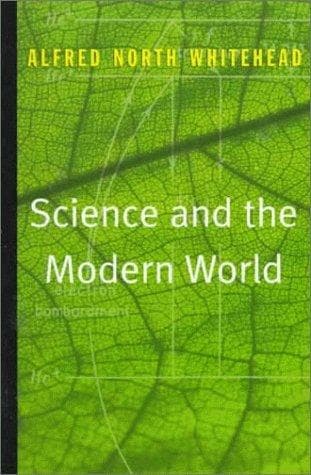
Science and the modern worldWhitehead, Alfred North
Religion
Science and the modern world
Whitehead, Alfred North
Science
in _Meditation III_: “...; for, as I before remarked, although the
things which I perceive or imagine are perhaps nothing at all apart from
me, I am nevertheless assured that those modes of consciousness which I
call perceptions and imaginations, in as far only as they are modes of
consciousness, exist in me.”
Footnote 12:
Quoted from Veitch’s translation.
The objectivism of the medieval and the ancient worlds passed over into
science. Nature is there conceived as for itself, with its own mutual
reactions. Under the recent influence of relativity, there has been a
tendency towards subjectivist formulations. But, apart from this recent
exception, nature, in scientific thought, has had its laws formulated
without any reference to dependence on individual observers. There is,
however, this difference between the older and the later attitudes
towards science. The anti-rationalism of the moderns has checked any
attempt to harmonise the ultimate concepts of science with ideas drawn
from a more concrete survey of the whole of reality. The material, the
space, the time, the various laws concerning the transition of material
configurations, are taken as ultimate stubborn facts, not to be tampered
with.
The effect of this antagonism to philosophy has been equally unfortunate
both for philosophy and for science. In this lecture we are concerned
with philosophy. Philosophers are rationalists. They are seeking to go
behind stubborn and irreducible facts: they wish to explain in the light
of universal principles the mutual reference between the various details
entering into the flux of things. Also, they seek such principles as
will eliminate mere arbitrariness; so that, whatever portion of fact is
assumed or given, the existence of the remainder of things shall satisfy
some demand of rationality. They demand meaning. In the words of Henry
Sidgwick[13]—“It is the primary aim of philosophy to unify completely,
bring into clear coherence, all departments of rational thought, and
this aim cannot be realised by any philosophy that leaves out of its
view the important body of judgments and reasonings which form the
subject matter of ethics.” Accordingly, the bias towards history on the
part of the physical and social sciences with their refusal to
rationalise below some ultimate mechanism, has pushed philosophy out of
the effective currents of modern life. It has lost its proper rôle as a
constant critic of partial formulations. It has retreated into the
subjectivist sphere of mind, by reason of its expulsion by science from
the objectivist sphere of matter. Thus the evolution of thought in the
seventeenth century coöperated with the enhanced sense of individual
personality derived from the Middle Ages. We see Descartes taking his
stand upon his own ultimate mind, which his philosophy assures him of;
and asking about its relations to the ultimate matter—exemplified, in
the second _Meditation_, by the human body and a lump of wax—which his
science assumes.
Public-domain text, read in full here on John Shaqi.
Reviews
Reviews
No reviews yet
Be the first to share your thoughts on this work.
Elsewhere in the archive
Join the Discussion
Join the discussion
Sign in to leave a comment or review.
Sign InorCreate an account