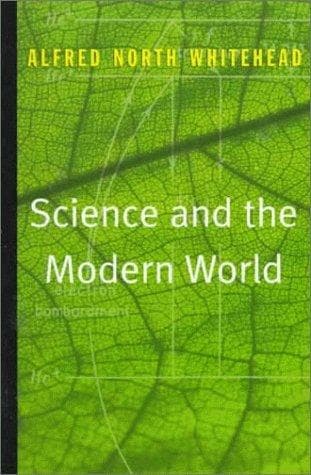
Science and the modern worldWhitehead, Alfred North
Religion
Science and the modern world
Whitehead, Alfred North
Science
One reason for this difficulty is that we cannot think first and act
afterwards. From the moment of birth we are immersed in action, and can
only fitfully guide it by taking thought. We have, therefore, in various
spheres of experience to adopt those ideas which seem to work within
those spheres. It is absolutely necessary to trust to ideas which are
generally adequate, even though we know that there are subtleties and
distinctions beyond our ken. Also apart from the necessities of action,
we cannot even keep before our minds the whole evidence except under the
guise of doctrines which are incompletely harmonised. We cannot think in
terms of an indefinite multiplicity of detail; our evidence can acquire
its proper importance only if it comes before us marshalled by general
ideas. These ideas we inherit—they form the tradition of our
civilisation. Such traditional ideas are never static. They are either
fading into meaningless formulae, or are gaining power by the new lights
thrown by a more delicate apprehension. They are transformed by the urge
of critical reason, by the vivid evidence of emotional experience, and
by the cold certainties of scientific perception. One fact is certain,
you cannot keep them still. No generation can merely reproduce its
ancestors. You may preserve the life in a flux of form, or preserve the
form amid an ebb of life. But you cannot permanently enclose the same
life in the same mould.
The present state of religion among the European races illustrates the
statements which I have been making. The phenomena are mixed. There have
been reactions and revivals. But on the whole, during many generations,
there has been a gradual decay of religious influence in European
civilisation. Each revival touches a lower peak than its predecessor,
and each period of slackness a lower depth. The average curve marks a
steady fall in religious tone. In some countries the interest in
religion is higher than in others. But in those countries where the
interest is relatively high, it still falls as the generations pass.
Religion is tending to degenerate into a decent formula wherewith to
embellish a comfortable life. A great historical movement on this scale
results from the convergence of many causes. I wish to suggest two of
them which lie within the scope of this chapter for consideration.
Public-domain text, read in full here on John Shaqi.
Reviews
Reviews
No reviews yet
Be the first to share your thoughts on this work.
Elsewhere in the archive
Join the Discussion
Join the discussion
Sign in to leave a comment or review.
Sign InorCreate an account