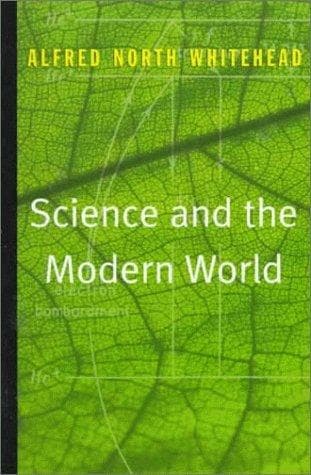
Science and the modern worldWhitehead, Alfred North
Religion
Science and the modern world
Whitehead, Alfred North
Science
It has been the purpose of these lectures to analyse the reactions of
science in forming that background of instinctive ideas which control
the activities of successive generations. Such a background takes the
form of a certain vague philosophy as to the last word about things,
when all is said. The three centuries, which form the epoch of modern
science, have revolved round the ideas of _God_, _mind_, _matter_, and
also of _space_ and _time_ in their characters of expressing _simple
location_ for matter. Philosophy has on the whole emphasised _mind_, and
has thus been out of touch with science during the two latter centuries.
But it is creeping back into its old importance owing to the rise of
psychology and its alliance with physiology. Also, this rehabilitation
of philosophy has been facilitated by the recent breakdown of the
seventeenth century settlement of the principles of physical science.
But, until that collapse, science seated itself securely upon the
concepts of matter, space, time, and latterly, of energy. Also there
were arbitrary laws of nature determining locomotion. They were
empirically observed, but for some obscure reason were known to be
universal. Anyone who in practice or theory disregarded them was
denounced with unsparing vigour. This position on the part of scientists
was pure bluff, if one may credit them with believing their own
statements. For their current philosophy completely failed to justify
the assumption that the immediate knowledge inherent in any present
occasion throws any light either on its past, or its future.
I have also sketched an alternative philosophy of science in which
_organism_ takes the place of _matter_. For this purpose, the mind
involved in the materialist theory dissolves into a function of
organism. The psychological field then exhibits what an event is in
itself. Our bodily event is an unusually complex type of organism and
consequently includes cognition. Further, space and time, in their most
concrete signification, become the locus of events. An organism is the
realisation of a definite shape of value. The emergence of some actual
value depends on limitation which excludes neutralising cross-lights.
Thus an event is a matter of fact which by reason of its limitation is a
value for itself; but by reason of its very nature it also requires the
whole universe in order to be itself.
Importance depends on endurance. Endurance is the retention through time
of an achievement of value. What endures is identity of pattern,
self-inherited. Endurance requires the favourable environment. The whole
of science revolves round this question of enduring organisms.
Public-domain text, read in full here on John Shaqi.
Reviews
Reviews
No reviews yet
Be the first to share your thoughts on this work.
Elsewhere in the archive
Join the Discussion
Join the discussion
Sign in to leave a comment or review.
Sign InorCreate an account