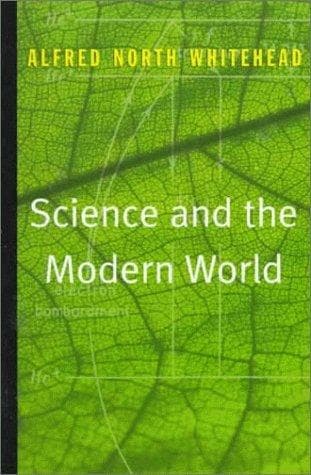
Science and the modern worldWhitehead, Alfred North
Religion
Science and the modern world
Whitehead, Alfred North
Science
Also the assumption of the bare valuelessness of mere matter led to a
lack of reverence in the treatment of natural or artistic beauty. Just
when the urbanisation of the western world was entering upon its state
of rapid development, and when the most delicate, anxious consideration
of the aesthetic qualities of the new material environment was
requisite, the doctrine of the irrelevance of such ideas was at its
height. In the most advanced industrial countries, art was treated as a
frivolity. A striking example of this state of mind in the middle of the
nineteenth century is to be seen in London where the marvellous beauty
of the estuary of the Thames, as it curves through the city, is wantonly
defaced by the Charing Cross railway bridge, constructed apart from any
reference to aesthetic values.
The two evils are: one, the ignoration of the true relation of each
organism to its environment; and the other, the habit of ignoring the
intrinsic worth of the environment which must be allowed its weight in
any consideration of final ends.
Another great fact confronting the modern world is the discovery of the
method of training professionals, who specialise in particular regions
of thought and thereby progressively add to the sum of knowledge within
their respective limitations of subject. In consequence of the success
of this professionalising of knowledge, there are two points to be kept
in mind, which differentiate our present age from the past. In the first
place, the rate of progress is such that an individual human being, of
ordinary length of life, will be called upon to face novel situations
which find no parallel in his past. The fixed person for the fixed
duties, who in older societies was such a godsend, in the future will be
a public danger. In the second place, the modern professionalism in
knowledge works in the opposite direction so far as the intellectual
sphere is concerned. The modern chemist is likely to be weak in zoology,
weaker still in his general knowledge of the Elizabethan drama, and
completely ignorant of the principles of rhythm in English
versification. It is probably safe to ignore his knowledge of ancient
history. Of course I am speaking of general tendencies; for chemists are
no worse than engineers, or mathematicians, or classical scholars.
Effective knowledge is professionalised knowledge, supported by a
restricted acquaintance with useful subjects subservient to it.
Public-domain text, read in full here on John Shaqi.
Reviews
Reviews
No reviews yet
Be the first to share your thoughts on this work.
Elsewhere in the archive
Join the Discussion
Join the discussion
Sign in to leave a comment or review.
Sign InorCreate an account