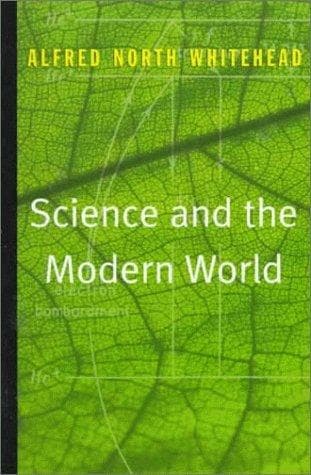
Science and the modern worldWhitehead, Alfred North
Religion
Science and the modern world
Whitehead, Alfred North
Science
In regard to the aesthetic needs of civilised society the reactions of
science have so far been unfortunate. Its materialistic basis has
directed attention to _things_ as opposed to _values_. The antithesis is
a false one, if taken in a concrete sense. But it is valid at the
abstract level of ordinary thought. This misplaced emphasis coalesced
with the abstractions of political economy, which are in fact the
abstractions in terms of which commercial affairs are carried on. Thus
all thought concerned with social organisation expressed itself in terms
of material things and of capital. Ultimate values were excluded. They
were politely bowed to, and then handed over to the clergy to be kept
for Sundays. A creed of competitive business morality was evolved, in
some respects curiously high; but entirely devoid of consideration for
the value of human life. The workmen were conceived as mere hands, drawn
from the pool of labour. To God’s question, men gave the answer of
Cain—“Am I my brother’s keeper?”; and they incurred Cain’s guilt. This
was the atmosphere in which the industrial revolution was accomplished
in England, and to a large extent elsewhere. The internal history of
England during the last half century has been an endeavour slowly and
painfully to undo the evils wrought in the first stage of the new epoch.
It may be that civilisation will never recover from the bad climate
which enveloped the introduction of machinery. This climate pervaded the
whole commercial system of the progressive northern European races. It
was partly the result of the aesthetic errors of Protestantism and
partly the result of scientific materialism, and partly the result of
the natural greed of mankind, and partly the result of the abstractions
of political economy. An illustration of my point is to be found in
Macaulay’s Essay criticising Southey’s _Colloquies on Society_. It was
written in 1830. Now Macaulay was a very favourable example of men
living at that date, or at any date. He had genius; he was kind-hearted,
honourable, and a reformer. This is the extract:—“We are told, that our
age has invented atrocities beyond the imagination of our fathers; that
society has been brought into a state compared with which extermination
would be a blessing; and all because the dwellings of cotton-spinners
are naked and rectangular. Mr. Southey has found out a way he tells us,
in which the effects of manufactures and agriculture may be compared.
And what is this way? To stand on a hill, to look at a cottage and a
factory, and to see which is the prettier.”
Public-domain text, read in full here on John Shaqi.
Reviews
Reviews
No reviews yet
Be the first to share your thoughts on this work.
Elsewhere in the archive
Join the Discussion
Join the discussion
Sign in to leave a comment or review.
Sign InorCreate an account