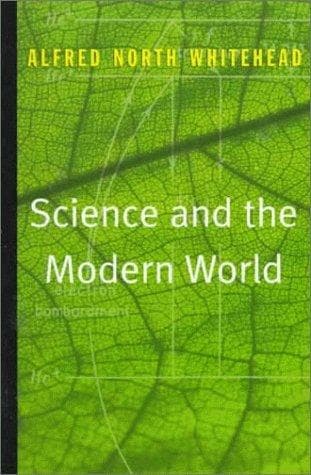
Science and the modern worldWhitehead, Alfred North
Religion
Science and the modern world
Whitehead, Alfred North
Science
Modern science has imposed on humanity the necessity for wandering. Its
progressive thought and its progressive technology make the transition
through time, from generation to generation, a true migration into
uncharted seas of adventure. The very benefit of wandering is that it is
dangerous and needs skill to avert evils. We must expect, therefore,
that the future will disclose dangers. It is the business of the future
to be dangerous; and it is among the merits of science that it equips
the future for its duties. The prosperous middle classes, who ruled the
nineteenth century, placed an excessive value upon placidity of
existence. They refused to face the necessities for social reform
imposed by the new industrial system, and they are now refusing to face
the necessities for intellectual reform imposed by the new knowledge.
The middle class pessimism over the future of the world comes from a
confusion between civilisation and security. In the immediate future
there will be less security than in the immediate past, less stability.
It must be admitted that there is a degree of instability which is
inconsistent with civilisation. But, on the whole, the great ages have
been unstable ages.
I have endeavoured in these lectures to give a record of a great
adventure in the region of thought. It was shared in by all the races of
western Europe. It developed with the slowness of a mass movement. Half
a century is its unit of time. The tale is the epic of an episode in the
manifestation of reason. It tells how a particular direction of reason
emerges in a race by the long preparation of antecedent epochs, how
after its birth its subject-matter gradually unfolds itself, how it
attains its triumphs, how its influence moulds the very springs of
action of mankind, and finally how at its moment of supreme success its
limitations disclose themselves and call for a renewed exercise of the
creative imagination. The moral of the tale is the power of reason, its
decisive influence on the life of humanity. The great conquerors, from
Alexander to Caesar, and from Caesar to Napoleon, influenced profoundly
the lives of subsequent generations. But the total effect of this
influence shrinks to insignificance, if compared to the entire
transformation of human habits and human mentality produced by the long
line of men of thought from Thales to the present day, men individually
powerless, but ultimately the rulers of the world.
INDEX
The numbers refer to pages; and ‘_e.s._’ stands for ‘_et seqq._’, where
the reference is to the succeeding pages of the chapter in question.
Public-domain text, read in full here on John Shaqi.
Reviews
Reviews
No reviews yet
Be the first to share your thoughts on this work.
Elsewhere in the archive
Join the Discussion
Join the discussion
Sign in to leave a comment or review.
Sign InorCreate an account