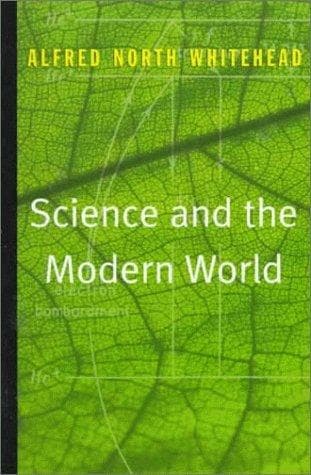
Science and the modern worldWhitehead, Alfred North
Religion
Science and the modern world
Whitehead, Alfred North
Science
In the realm of practice, the age which produced enlightened rulers,
such as the Emperor Joseph of the House of Hapsburg, Frederick the
Great, Walpole, the great Lord Chatham, George Washington, cannot be
said to have failed. Especially when to these rulers, it adds the
invention of parliamentary cabinet government in England, of federal
presidential government in the United States, and of the humanitarian
principles of the French Revolution. Also in technology it produced the
steam-engine, and thereby ushered in a new era of civilisation.
Undoubtedly, as a practical age the eighteenth century was a success. If
you had asked one of the wisest and most typical of its ancestors, who
just saw its commencement, I mean John Locke, what he expected from it,
he would hardly have pitched his hopes higher than its actual
achievements.
In developing a criticism of the scientific scheme of the eighteenth
century, I must first give my main reason for ignoring nineteenth
century idealism—I am speaking of the philosophic idealism which finds
the ultimate meaning of reality in mentality that is fully cognitive.
This idealistic school, as hitherto developed, has been too much
divorced from the scientific outlook. It has swallowed the scientific
scheme in its entirety as being the only rendering of the facts of
nature, and has then explained it as being an idea in the ultimate
mentality. In the case of absolute idealism, the world of nature is just
one of the ideas, somehow differentiating the unity of the Absolute: in
the case of pluralistic idealism involving monadic mentalities, this
world is the greatest common measure of the various ideas which
differentiate the various mental unities of the various monads. But,
however you take it, these idealistic schools have conspicuously failed
to connect, in any organic fashion, the fact of nature with their
idealistic philosophies. So far as concerns what will be said in these
lectures, your ultimate outlook may be realistic or idealistic. My point
is that a further stage of provisional realism is required in which the
scientific scheme is recast, and founded upon the ultimate concept of
_organism_.
Public-domain text, read in full here on John Shaqi.
Reviews
Reviews
No reviews yet
Be the first to share your thoughts on this work.
Elsewhere in the archive
Join the Discussion
Join the discussion
Sign in to leave a comment or review.
Sign InorCreate an account