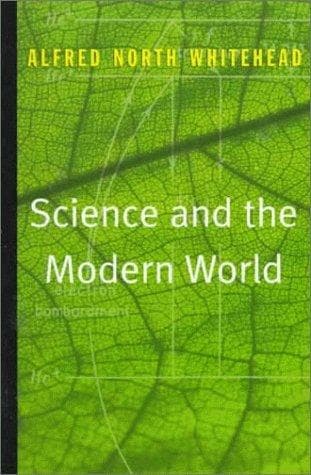
Science and the modern worldWhitehead, Alfred North
Religion
Science and the modern world
Whitehead, Alfred North
Science
Wordsworth was born among hills; hills mostly barren of trees, and thus
showing the minimum of change with the seasons. He was haunted by the
enormous permanences of nature. For him change is an incident which
shoots across a background of endurance,
“Breaking the silence of the seas
Among the farthest Hebrides.”
Every scheme for the analysis of nature has to face these two facts,
_change_ and _endurance_. There is yet a third fact to be placed by it,
_eternality_, I will call it. The mountain endures. But when after ages
it has been worn away, it has gone. If a replica arises, it is yet a new
mountain. A colour is eternal. It haunts time like a spirit. It comes
and it goes. But where it comes, it is the same colour. It neither
survives nor does it live. It appears when it is wanted. The mountain
has to time and space a different relation from that which colour has.
In the previous lecture, I was chiefly considering the relation to
space-time of things which, in my sense of the term, are eternal. It was
necessary to do so before we can pass to the consideration of the things
which endure.
Also we must recollect the basis of our procedure. I hold that
philosophy is the critic of abstractions. Its function is the double
one, first of harmonising them by assigning to them their right relative
status as abstractions, and secondly of completing them by direct
comparison with more concrete intuitions of the universe, and thereby
promoting the formation of more complete schemes of thought. It is in
respect to this comparison that the testimony of great poets is of such
importance. Their survival is evidence that they express deep intuitions
of mankind penetrating into what is universal in concrete fact.
Philosophy is not one among the sciences with its own little scheme of
abstractions which it works away at perfecting and improving. It is the
survey of sciences, with the special objects of their harmony, and of
their completion. It brings to this task, not only the evidence of the
separate sciences, but also its own appeal to concrete experience. It
confronts the sciences with concrete fact.
The literature of the nineteenth century, especially its English poetic
literature, is a witness to the discord between the aesthetic intuitions
of mankind and the mechanism of science. Shelley brings vividly before
us the elusiveness of the eternal objects of sense as they haunt the
change which infects underlying organisms. Wordsworth is the poet of
nature as being the field of enduring permanences carrying within
themselves a message of tremendous significance. The eternal objects are
also there for him,
“The light that never was, on sea or land.”
Public-domain text, read in full here on John Shaqi.
Reviews
Reviews
No reviews yet
Be the first to share your thoughts on this work.
Elsewhere in the archive
Join the Discussion
Join the discussion
Sign in to leave a comment or review.
Sign InorCreate an account