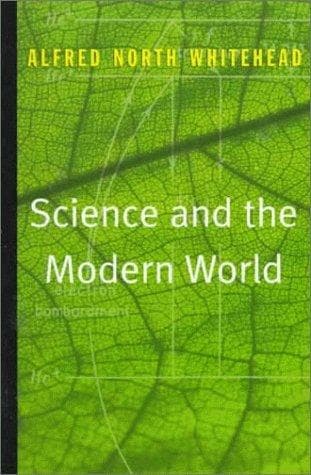
Science and the modern worldWhitehead, Alfred North
Religion
Science and the modern world
Whitehead, Alfred North
Science
The convergent effect of the new power for scientific advance, which
resulted from these four ideas, transformed the middle period of the
century into an orgy of scientific triumph. Clear-sighted men, of the
sort who are so clearly wrong, now proclaimed that the secrets of the
physical universe were finally disclosed. If only you ignored everything
which refused to come into line, your powers of explanation were
unlimited. On the other side, muddle-headed men muddled themselves into
the most indefensible positions. Learned dogmatism, conjoined with
ignorance of the crucial facts, suffered a heavy defeat from the
scientific advocates of new ways. Thus to the excitement derived from
technological revolution, there was now added the excitement arising
from the vistas disclosed by scientific theory. Both the material and
the spiritual bases of social life were in process of transformation.
When the century entered upon its last quarter, its three sources of
inspiration, the romantic, the technological, and the scientific had
done their work.
Then, almost suddenly, a pause occurred; and in its last twenty years
the century closed with one of the dullest stages of thought since the
time of the First Crusade. It was an echo of the eighteenth century,
lacking Voltaire and the reckless grace of the French aristocrats. The
period was efficient, dull, and half-hearted. It celebrated the triumph
of the professional man.
But looking backwards upon this time of pause, we can now discern signs
of change. In the first place, the modern conditions of systematic
research prevent absolute stagnation. In every branch of science, there
was effective progress, indeed rapid progress, although it was confined
somewhat strictly within the accepted ideas of each branch. It was an
age of successful scientific orthodoxy, undisturbed by much thought
beyond the conventions.
In the second place, we can now see that the adequacy of scientific
materialism as a scheme of thought for the use of science was
endangered. The conservation of energy provided a new type of
quantitative permanence. It is true that energy could be construed as
something subsidiary to matter. But, anyhow, the notion of _mass_ was
losing its unique preeminence as being the one final permanent quantity.
Later on, we find the relations of mass and energy inverted; so that
mass now becomes the name for a quantity of energy considered in
relation to some of its dynamical effects. This train of thought leads
to the notion of energy being fundamental, thus displacing matter from
that position. But energy is merely the name for the quantitative aspect
of a structure of happenings; in short, it depends on the notion of the
functioning of an organism. The question is, can we define an organism
without recurrence to the concept of matter in simple location? We must,
later on, consider this point in more detail.
Public-domain text, read in full here on John Shaqi.
Reviews
Reviews
No reviews yet
Be the first to share your thoughts on this work.
Elsewhere in the archive
Join the Discussion
Join the discussion
Sign in to leave a comment or review.
Sign InorCreate an account