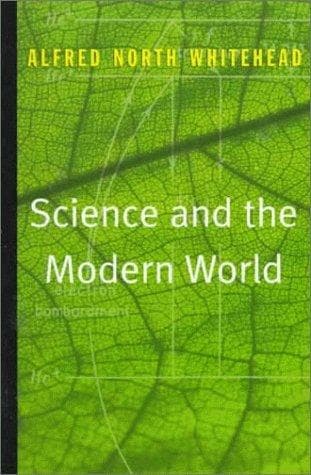
Science and the modern worldWhitehead, Alfred North
Religion
Science and the modern world
Whitehead, Alfred North
Science
Science is taking on a new aspect which is neither purely physical, nor
purely biological. It is becoming the study of organisms. Biology is the
study of the larger organisms; whereas physics is the study of the
smaller organisms. There is another difference between the two divisions
of science. The organisms of biology include as ingredients the smaller
organisms of physics; but there is at present no evidence that the
smaller of the physical organisms can be analysed into component
organisms. It may be so. But anyhow we are faced with the question as to
whether there are not primary organisms which are incapable of further
analysis. It seems very unlikely that there should be any infinite
regress in nature. Accordingly, a theory of science which discards
materialism must answer the question as to the character of these
primary entities. There can be only one answer on this basis. We must
start with the event as the ultimate unit of natural occurrence. An
event has to do with all that there is, and in particular with all other
events. This interfusion of events is effected by the aspects of those
eternal objects, such as colours, sounds, scents, geometrical
characters, which are required for nature and are not emergent from it.
Such an eternal object will be an ingredient of one event under the
guise, or aspect, of qualifying another event. There is a reciprocity of
aspects, and there are patterns of aspects. Each event corresponds to
two such patterns; namely, the pattern of aspects of other events which
it grasps into its own unity, and the pattern of its aspects which other
events severally grasp into their unities. Accordingly, a
non-materialistic philosophy of nature will identify a primary organism
as being the emergence of some particular pattern as grasped in the
unity of a real event. Such a pattern will also include the aspects of
the event in question as grasped in other events, whereby those other
events receive a modification, or partial determination. There is thus
an intrinsic and an extrinsic reality of an event, namely, the event as
in its own prehension, and the event as in the prehension of other
events. The concept of an organism includes, therefore, the concept of
the interaction of organisms. The ordinary scientific ideas of
transmission and continuity are, relatively speaking, details concerning
the empirically observed characters of these patterns throughout space
and time. The position here maintained is that the relationships of an
event are internal, so far as concerns the event itself; that is to say,
that they are constitutive of what the event is in itself.
Public-domain text, read in full here on John Shaqi.
Reviews
Reviews
No reviews yet
Be the first to share your thoughts on this work.
Elsewhere in the archive
Join the Discussion
Join the discussion
Sign in to leave a comment or review.
Sign InorCreate an account