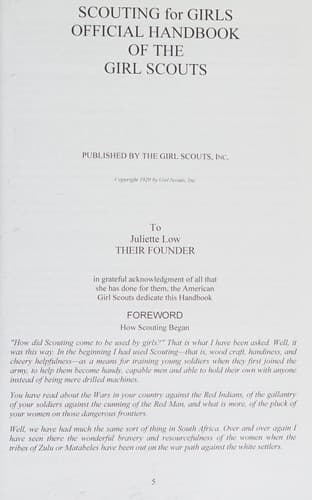
Scouting For Girls, Official Handbook of the Girl ScoutsGirl Scouts of the United States of America
History
Scouting For Girls, Official Handbook of the Girl Scouts
Girl Scouts of the United States of America
Girl Scouts -- Handbooks, manuals, etc.
Girls and women in attempting to live an outdoor life or indeed when
trying to do many of the things numbered among the Scout activities,
such as First Aid, Home Nursing and Hiking, often give themselves quite
unnecessary pain and fatigue from lifting, pulling and carrying weights
in the wrong way. Ability to carry and lift or move is not so much
dependent upon absolute strength as it is on knowing how. The whole
body, so far as it is a physical mechanism, may be thought of as a
series of levers, of which the muscles, bones, and joints make up the
parts and are fulcrum, power arm or weight arm as the case may be.
Without going into the details of bodily structure or even knowing the
names of the different bones and muscles, it is possible to learn a few
simple things about the right use of these levers that will be useful at
all times.
Certain parts of the body are more able to do heavy work than others,
and the first thing to remember is that the upper part of the back, the
shoulders and the upper arms are stronger than the lower back, the
abdomen and the lower arms. Therefore, whenever you are trying to lift
or move an object, see if you cannot use these stronger parts. If the
arms are held away from the body when lifting, pulling, throwing or
pushing, the muscles of the upper arm, the shoulders and the upper back
will be brought into play. If the arms are held close to the body, the
lower-arm muscles are unduly taxed and in trying to help them out,
pressure is made on the abdominal and pelvic muscles, which are not
fitted to bear this sort of strain. Therefore, in carrying a bag or
suitcase, where this is absolutely unavoidable, try to swing the arm
free from the body, so as to use the upper arm and back muscles for the
weight.
Another important way to save strain is by pushing instead of pulling.
It is almost impossible to push anything so hard as to injure your back
or abdominal muscles. It is almost impossible, on the other hand, to
pull even a relatively light weight without some strain. If you will
think of how a horse in harness actually exerts his strength in drawing
a wagon, you will see that what he does is to _push_ against the straps,
and it is the straps that _pull_ the wagon. Even the strongest horse
could not pull a wagon with his teeth very far, or pull something tied
only to the back leg muscles. _Get behind and push_ is the rule to
remember, and never resort to _pulling_ until you have tried every
device for pushing instead.
If you _must_ pull, try to use heavy muscles, such as _leg_ muscles, to
do it with. Often a weight may be lifted or pulled by getting the foot
under or in back and using the arms only to steer with. This applies
particularly to objects like trunks or bureaus.
Public-domain text, read in full here on John Shaqi.
Reviews
Reviews
No reviews yet
Be the first to share your thoughts on this work.
Elsewhere in the archive
Join the Discussion
Join the discussion
Sign in to leave a comment or review.
Sign InorCreate an account