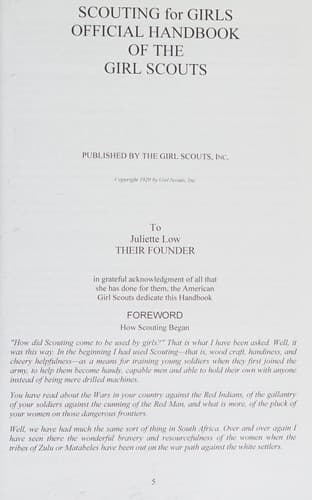
Scouting For Girls, Official Handbook of the Girl ScoutsGirl Scouts of the United States of America
History
Scouting For Girls, Official Handbook of the Girl Scouts
Girl Scouts of the United States of America
Girl Scouts -- Handbooks, manuals, etc.
These may be divided into Coral Snakes, Moccasins, and Rattlers.
The coral snakes are found in the Southern States. They are very much
like harmless snakes in shape, but are easily distinguished by their
remarkable colors, "broad alternating rings of red and black, the latter
bordered with very narrow rings of yellow."
The Rattlesnakes are readily told at once by the rattle.
But the Moccasins are not so easy. There are two kinds: the Water
Moccasin, or Cotton-mouth, found in South Carolina, Georgia, Florida,
Alabama, and Louisiana, and the Copperhead, which is the Highland, or
Northern Moccasin or Pilot Snake, found from Massachusetts to Florida
and west to Illinois and Texas.
[Illustration: Types of Poisonous Snakes
Coral Snake
Copperhead
Moccasin
Pigmy Rattler
Timber Rattler
Diamond-back Rattler]
Here are distinguishing marks: The Moccasins, as well as the Rattlers,
have on each side of the head, between the eye and nostril, a deep pit.
The pupil of the eye is an upright line, as in a cat; the harmless
snakes have a round pupil.
The Moccasins have a single row of plates under the tail, while the
harmless snakes have a double row.
The Water Moccasin is dull olive with wide black transverse bands.
The Copperhead is dull hazel brown, marked across the back with
dumb-bells of reddish brown; the top of the head more or less coppery.
Both Moccasins and Rattlers have a flat triangular head, which is much
wider than the thin neck; while most harmless snakes have a narrow head
that shades off into the neck.
Rattlesnakes are found generally distributed over the United States,
southern Ontario, southern Alberta, and Saskatchewan.
How Does a Snake Bite
Remember, the tongue is a feeler, not a sting. The "stinging" is done by
two long hollow teeth, or fangs, through which the poison is squirted
into the wound.
The striking distance of a snake is about one-third the creature's
length, and the stroke is so swift that no creature can dodge it.
The snake can strike farthest and surest when it is ready coiled, but
can strike a little way when traveling.
You cannot disarm a poisonous snake without killing it. If the fangs are
removed others come quickly to take their place. In fact, a number of
small, half-grown fangs are always waiting ready to be developed.
In Case of Snake Bite
First, keep cool, and remember that the bite of American snakes is
seldom fatal if the proper measures are followed.
Public-domain text, read in full here on John Shaqi.
Reviews
Reviews
No reviews yet
Be the first to share your thoughts on this work.
Elsewhere in the archive
Join the Discussion
Join the discussion
Sign in to leave a comment or review.
Sign InorCreate an account