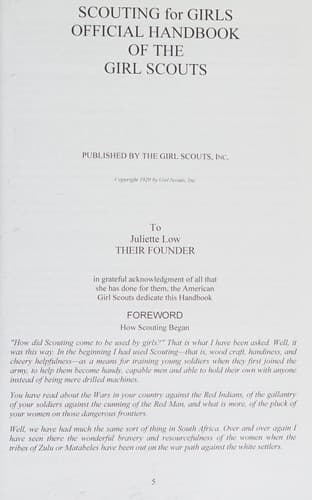
Scouting For Girls, Official Handbook of the Girl ScoutsGirl Scouts of the United States of America
History
Scouting For Girls, Official Handbook of the Girl Scouts
Girl Scouts of the United States of America
Girl Scouts -- Handbooks, manuals, etc.
Thus we have described ten constellations from which the woodcrafter
may select the number needed to qualify, namely, the Little Bear, or
Little Dipper, the Big Dipper or Big Bear, Cassiopeia's Chair, the Bull,
Orion's Hound, Orion's Little Dog, the Pleiades and the Hyades; the Lyre
(later).
The Moon
The moon is one-fourth the diameter of the earth, about one-fiftieth of
the bulk, and is about a quarter of a million miles away. Its course,
while very irregular, is nearly the same as the apparent course of the
sun. It is a cold solid body, without any known atmosphere, and shines
by reflected sunlight.
The moon goes around the earth in twenty-seven and a quarter days. It
loses about fifty-one minutes in twenty-fours hours; therefore it rises
that much later each successive night on the average, but there are wide
deviations from this average, as for example, the time of the Harvest
and Hunter's moons in the fall, when the full moon rises at nearly the
same time for several nights in succession.
According to most authorities, the moon is a piece of the earth that
broke away some time ago; and it has followed its mother around ever
since.
The Stars as Tests of Eyesight
In the sky are several tests of eyesight which have been there for some
time and are likely to be. The first is the old test of Mizar and Alcor.
Mizar, the Horse, is the star at the bend of the handle of the Dipper.
Just above it is a very small star that astronomers call Alcor, or the
rider.
The Indians call these two the "Old Squaw and the Papoose on Her Back."
In the old world, from very ancient times, these have been used as tests
of eyesight. To be able to see Alcor with the naked eye means that one
has excellent eyesight. So also on the plains, the old folks would ask
the children at night, "Can you see the papoose on the old Squaw's
back?" And when the youngster saw it and proved that he did by a right
description, they rejoiced that he had the eyesight which is the first
requisite of a good hunter.
One of the oldest of all eye tests is the Pleiades. Poor eyes see a mere
haze, fairly good see five, good see six, excellent see seven. The
rarest eyesight, under the best conditions, see up to ten; and,
according to Flammarion, the record with unaided eyes is thirteen.
Vega of the Lyre
If one draw a line from through the back wall of the Dipper, that is,
from the back bottom star, through the one next the handle, and continue
it upward for twice the total length of the Dipper, it will reach Vega,
the brightest star in the northern part of the sky, and believed to have
been at one time the Pole-star--and likely to be again. Vega, with the
two stars near it, form a small triangle. The one on the side next the
North Star is called Epsillon. If you have remarkably good eyes, you
will see that it is a double star.
The Nebula in Orion's Sword
Public-domain text, read in full here on John Shaqi.
Reviews
Reviews
No reviews yet
Be the first to share your thoughts on this work.
Elsewhere in the archive
Join the Discussion
Join the discussion
Sign in to leave a comment or review.
Sign InorCreate an account