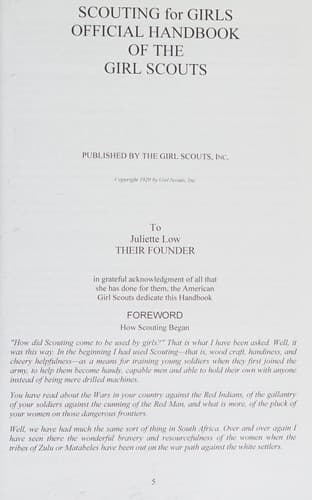
Scouting For Girls, Official Handbook of the Girl ScoutsGirl Scouts of the United States of America
History
Scouting For Girls, Official Handbook of the Girl Scouts
Girl Scouts of the United States of America
Girl Scouts -- Handbooks, manuals, etc.
"_The Indian's Fire_--Best where fuel is scarce, or when one has only a
small hatchet with which to cut night wood. Fell and trim a lot of
hardwood saplings. Lay three or four of them on the ground, butts on top
of each other, tips radiating from this center like the spokes of a
wheel. On and around this build a small hot fire. Place butts of other
saplings on this, radiating like the others. As the wood burns away,
shove the sticks in toward the center, butts on top of each other as
before. This saves much chopping, and economizes fuel. Build a little
wind break behind you and lie close to the fire. Doubtless you have
heard the Indian's dictum (southern Indians express it just as the
northern ones do): 'White man heap fool; make um big fire--can't git
near; Injun make um little fire--git close. Uh, good.'
Kindling
"The best kindling is fat pine or the bark of the paper birch. Fat pine
is found in the stumps and butt cuts of pine trees, particularly those
that died on the stump. The resin has collected there and dried. This
wood is usually easy to split. Pine knots are the tough, heavy resinous
stubs of limbs that are found on dead pine trees. They, as well as fat
pine, are almost imperishable, and those sticking out of old rotten logs
are as good as any. In collecting pine knots go to fallen trees that are
almost rotted away. Hit the knot a lick with the pole of the axe and
generally it will yield; if you must chop, cut deep to get it all and to
save the axe edge. The knots of old dead balsams are similarly used.
Usually a dead stump of pine, spruce, or balsam, all punky on the
outside, has a core very rich in resin that makes excellent kindling.
"Hemlock knots are worthless and hard as glass--keep your axe out of
them.
"The thick bark of hemlock is good to make glowing coals in a hurry; so
is that of hard woods generally. Good kindling sure to be dry underneath
the bark in all weather, is procured by snapping off the small dead
branches, or stubs of branches, that are left on the trunks of small or
medium-sized trees, near the ground. Do not pick up twigs from the
ground, but choose those among the downwood that are held up free from
the ground. Where a tree is found that has been shivered by lightning,
or one that has broken off without uprooting, good splinters of dry wood
will be found. In every laurel thicket there is plenty of dead laurel,
and, since it is of sprangling growth, most of the branches will be
free from the ground and snap-dry. They ignite readily and give out
intense heat.
"The bark of all species of birch, but of paper birch especially, is
excellent for kindling and for torches. It is full of resinous oil,
blazes up at once, will burn in any wind, and wet sticks can be ignited
with it.
Public-domain text, read in full here on John Shaqi.
Reviews
Reviews
No reviews yet
Be the first to share your thoughts on this work.
Elsewhere in the archive
Join the Discussion
Join the discussion
Sign in to leave a comment or review.
Sign InorCreate an account