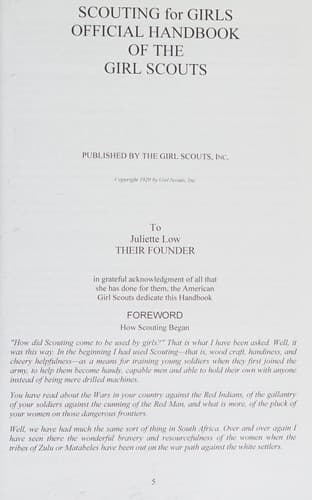
Scouting For Girls, Official Handbook of the Girl ScoutsGirl Scouts of the United States of America
History
Scouting For Girls, Official Handbook of the Girl Scouts
Girl Scouts of the United States of America
Girl Scouts -- Handbooks, manuals, etc.
The civic nature of these problems is appreciated when we realize that
it would do little good, for example, for one person to destroy the
breeding-places of mosquitoes on his premises, if his neighbors did not
do likewise about their homes; or for one orchardist to cut out the
blight from his pear-trees or the black-knot from his plum-trees, if his
neighbors did not co-operate with him by ridding their orchards of these
diseases.
These practical questions are so well presented, together with plans for
their solution, in _Civic Biology_, by Clifton F. Hodge and Jean Dawson
(Ginn & Co.), that instead of going into details here, both the _Girl
Scouts_ and their Leaders are referred to this most useful work.
All objects of Nature are either living (organic) or non-living
(inorganic). The non-living bodies include the minerals and rocks. The
living bodies are either plants or animals. Plants may be divided into
two great groups, the flowerless plants and flowering plants. In general
the flowerless plants reproduce by means of spores, like the mushroom
and the ferns, while the flowering plants reproduce by means of seeds.
[Illustration: ROCKY MOUNTAIN GOAT
This animal is really not a goat, but is more nearly related to the
antelopes. Range: The higher mountains from Alaska south to California.
Group in American Museum of Natural History.]
Animals may be separated into two great groups, those without backbones
(invertebrates) like an oyster, a cricket, or an earthworm, and those
with backbones, e.g., a dog, a fish. In this brief study we shall not go
into much detail about invertebrates, but with the backboned animals or
vertebrates we shall go a little further. These may be divided into five
general groups: (1) Fishes; (2) Amphibians, which include frogs, toads,
and salamanders; (3) Reptiles, which include alligators, crocodiles,
turtles, lizards, and snakes; (4) Birds; (5) Mammals.
This simple analysis may be clearly shown by the following diagram:
{_Mammals_
{_Birds_
{_Vertebrates_{_Reptiles_
{ {_Amphibians_
{ {_Fishes_
{_Animals_{
{ {_Invertebrates_
{_Living Bodies_{
{ (_Organic_) { {_Flowering Plants_
_Objects_{ { {_Flowerless Plants_
_of_ {
_Nature_ {_Non-living Bodies_
{ (_Inorganic_)
This classification could be carried further at every point, but this
will be far enough for present purposes. It should be remembered in any
classification that there are no hard and fast lines in Nature. For
example, some creatures are on the border-land between plants and
animals, and again some animals are between the backboned animals and
those without backbones.
Public-domain text, read in full here on John Shaqi.
Reviews
Reviews
No reviews yet
Be the first to share your thoughts on this work.
Elsewhere in the archive
Join the Discussion
Join the discussion
Sign in to leave a comment or review.
Sign InorCreate an account