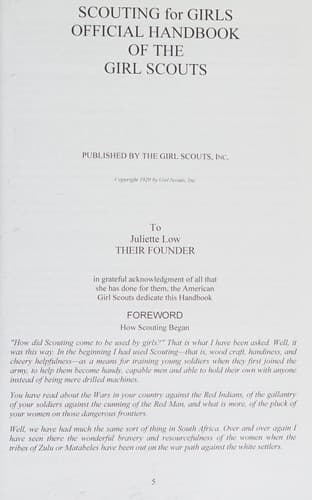
Scouting For Girls, Official Handbook of the Girl ScoutsGirl Scouts of the United States of America
History
Scouting For Girls, Official Handbook of the Girl Scouts
Girl Scouts of the United States of America
Girl Scouts -- Handbooks, manuals, etc.
_He who wanders widest lifts
No more of beauty's jealous veils,
Than he who from his doorway sees
The miracle of flowers and trees._
--_Whittier_
The trees of the forest are of two classes, deciduous trees and
evergreen trees. To the former belong those which shed their leaves in
the fall, are bare in the winter, and then grow a new crop of leaves in
the spring, e.g., oaks, elms, maples. The evergreen trees shed their
leaves also, but not all at one time. In fact, they always have a
goodly number of leaves, and are consequently green all the year round,
e.g., pines, spruces, firs.
[Illustration: RHODODENDRON OR GREAT LAUREL
A tall shrub, or sometimes a tree, growing in woods and along streams.
Range: Eastern North America from Nova Scotia to Georgia. Photograph by
Albert E. Butler.]
The uses of wood are so many and various that we can only begin to
mention them. In looking about us we see wood used in building houses,
in making furniture, for railroad ties, and for shoring timbers in
mines. In many country districts wood is used for fuel. And do you
realize that only a short time ago the newspaper which you read this
morning and the book which you now hold in your hand were parts of
growing trees in the forest? Paper is made of wood-pulp, mostly from
Spruce.
[Illustration: CHRISTMAS FERN
An evergreen fern growing in woods and rocky places. Range: Eastern
United States and Canada. Photograph by Mary C. Dickerson.]
Besides the direct uses of wood, we turn to the forest for many
interesting and valuable products, varying in importance from a
balsam-pillow filled with the fragrant leaves or needles of the Balsam
Fir, to turpentine and rosin (naval stores), produced chiefly by the
Long-leaved Pine of the Southeastern States. Spruce gum is obtained from
the Black Spruce and Red Spruce. Canada balsam used in cementing lenses
together in microscopes, telescopes, and the like, comes from the
Balsam Fir. Bark for tanning comes from Oak and Hemlock. The Indians of
the Eastern Woodlands or Great Lakes area made canoes and many other
useful articles of the bark of the Canoe or Paper Birch. Baskets are
made from Willow twigs. Maple sugar comes chiefly from the Sugar Maple.
[Illustration: IN A TURPENTINE GROVE
The long-leaved Pine furnishes most of the turpentine and rosin of
commerce. Range: Virginia to Florida and Texas. Photograph by G. Clyde
Fisher.]
[Illustration: BLACK SUGAR MAPLE
The sap of this tree, as well as the more common Sugar Maple, is the
source of maple sugar. Range: Eastern United States and southeastern
Canada.]
Public-domain text, read in full here on John Shaqi.
Reviews
Reviews
No reviews yet
Be the first to share your thoughts on this work.
Elsewhere in the archive
Join the Discussion
Join the discussion
Sign in to leave a comment or review.
Sign InorCreate an account