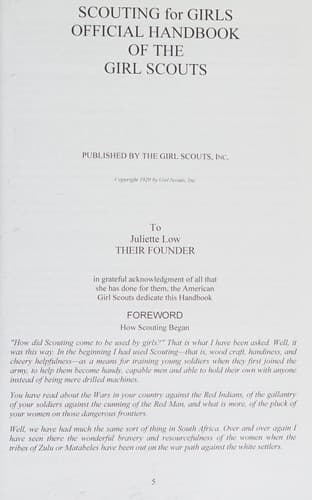
Scouting For Girls, Official Handbook of the Girl ScoutsGirl Scouts of the United States of America
History
Scouting For Girls, Official Handbook of the Girl Scouts
Girl Scouts of the United States of America
Girl Scouts -- Handbooks, manuals, etc.
Second, and chiefly related to this, is the fact that the floods upon
our rivers, which every year take such heavy toll in property and in
human life, are due to the cutting away of the forests. This allows the
water from rain and melting snow to reach the streams at times faster
than it can be carried off, and so we have a flood. The forest floor,
with its undergrowth and humus, in those localities where the forests
still exist about the headwaters of our rivers, acts like a huge layer
of blotting paper which holds the water back and allows it to escape to
the streams slowly, and so floods are avoided.
Third, and related to the above, is the fact that the water supply of
our cities would be more constant if the forests had not been cut away.
In these cases the summer droughts make much greater the danger from
water-borne diseases.
[Illustration: WESTERN YELLOW PINE
A magnificent tree which furnishes valuable timber. Range: Hills and
mountains of western United States. Photograph by Albert E. Butler.]
[Illustration: ROADS THROUGH THE ASPENS
Range: Northern United States and Canada, south in the Rocky Mountains
to Mexico. Photograph by Albert E. Butler.]
It is only in recent years that the American people have begun to
realize the necessity of the conservation of our forests, and in many
sections much has been done to redeem the criminal thoughtlessness in
destroying our forests and to restore those devastated by forest fires.
Reforestation operations have accomplished a great deal, and the
organization to prevent forest fires emphasizes the old adage that "an
ounce of prevention is worth a pound of cure." Also the people are being
taught correct forestry practices, such as cutting only ripe trees and
allowing the rest to grow, instead of clearing the land entirely, as was
formerly done so universally.
[Illustration: BALD CYPRESS DRAPED WITH SPANISH "MOSS."
This tree is almost entirely hidden by this "moss," which is really a
flowering plant of the Pineapple family. Range: In swamps and along
rivers from Delaware to Florida, west to Texas, north to Missouri and
southern Indiana. Photograph by G. Clyde Fisher.]
The life history of every tree is interesting; how it breathes by means
of its leaves, just as the animals do by means of gills or lungs; how it
manufactures starch by means of the green matter in the leaves; how the
starch is changed to sugar and other substances which are carried to
other parts of the tree in the sap; how the sap flows upward in the
vessels in the sap-wood and downward in the vessels of the inner bark;
how the entire heart-wood of a tree is dead and the only living part is
the sap-wood and the innermost bark.
One of the first things we shall want to know when we get out into the
woods is the name of the tree that interests us. For this purpose the
books given as references under "Trees" will be useful.
[Illustration: TIMBER WOLVES ON THE TRAIL
Public-domain text, read in full here on John Shaqi.
Reviews
Reviews
No reviews yet
Be the first to share your thoughts on this work.
Elsewhere in the archive
Join the Discussion
Join the discussion
Sign in to leave a comment or review.
Sign InorCreate an account