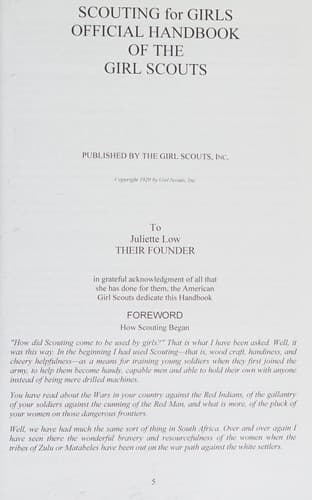
Scouting For Girls, Official Handbook of the Girl ScoutsGirl Scouts of the United States of America
History
Scouting For Girls, Official Handbook of the Girl Scouts
Girl Scouts of the United States of America
Girl Scouts -- Handbooks, manuals, etc.
There are a number of birds which are valuable friends to all the people
because they are scavengers. The Herring Gull, which is the commonest
gull of the harbors of the United States, and which is also found on
inland lakes and rivers, by feeding upon all kinds of refuse animal and
plant materials makes the waters about our cities more healthful. This
is especially true of the coast cities which dump their garbage into the
waters not far distant. The Turkey Vulture, the Black Vulture or
Carrion-Crow, and the California Condor make the fields and woods of the
country more healthful by devouring the carcasses of animals, and the
first two species eat the offal from slaughter houses and even scraps of
meat from the markets in some of our Southern cities.
[Illustration: COMMON TERN
A close relative of the gulls. Range: Northern Hemisphere, northern
South America and Africa.]
[Illustration: GREAT BLUE HERON
Frequently miscalled Blue "Crane." The long legs indicate that this is a
wading bird. Range: Western Hemisphere.]
The most valuable group of birds from the standpoint of the farmers, the
orchardists, and the gardeners is the insect-eating birds. Among these
are the Wood Pewee, the Phoebe, the Kingbird, and all of the
Flycatchers; the Purple Martin and all of the Swallows; the Nighthawk
and Whip-poor-will. The Yellow-billed and Black-billed Cuckoos and the
Baltimore Oriole feed largely upon tent caterpillars and others
caterpillars which defoliate the fruit and shade trees. The Sparrow
Hawk has been wrongly named, for it eats a thousand times as many
grasshoppers as it does sparrows. The Chickadees, Brown Creepers, and
many of the Warblers feed largely upon insects and insect eggs which
they glean chiefly from the trees. The Rose-breasted Grosbeak and the
Bob-White eat the Colorado potato-beetle. In the West the Franklin's
Gull follows the farmer in the fields and picks up great numbers of
destructive insects.
In learning the value of our feathered friends it is necessary to learn
to know the birds, and in this quest great help can be obtained from
books. Beginners will find the following useful:
"Land Birds East of the Rockies," by Chester A. Reed.
"Water and Game Birds," by Chester A. Reed.
"Western Bird Guide," by Chester A. Reed. (All published by Doubleday,
Page & Co.)
For more advanced students the following are recommended:
"Handbook of Birds of Eastern North America," by Frank M. Chapman (D.
Appleton & Co.).
"Handbook of Birds of Eastern North America," by Florence Merriam Bailey
(Houghton, Mifflin & Co.).
Our study of birds should not stop with the name, because we shall find
many things of interest in the home life of birds, many things that seem
to reflect our own lives. (See "Home Life of Wild Birds," by F. H.
Herrick. G. P. Putnam's Sons.)
Public-domain text, read in full here on John Shaqi.
Reviews
Reviews
No reviews yet
Be the first to share your thoughts on this work.
Elsewhere in the archive
Join the Discussion
Join the discussion
Sign in to leave a comment or review.
Sign InorCreate an account