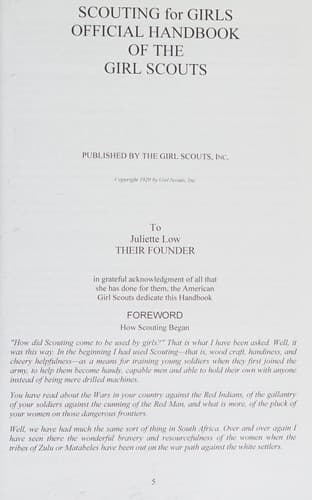
Scouting For Girls, Official Handbook of the Girl ScoutsGirl Scouts of the United States of America
History
Scouting For Girls, Official Handbook of the Girl Scouts
Girl Scouts of the United States of America
Girl Scouts -- Handbooks, manuals, etc.
[Illustration: THE KING OF THE NORTHLANDS]
GEOLOGY
_Finds tongues in trees, books in the running brooks,
Sermons in stones, and good in everything._
--_Shakespeare, As You Like It._
The Structure and History of the Earth
There is nothing eternal about the earth except eternal change, some one
has said. It requires only a little looking about us to see that this is
true. The earth is not as it was in the past. Every shower of rain
changes or modifies its surface. And many other and some very great
changes have occurred during the past few millions of years. During one
age, the coal was formed of plants that grew luxuriantly on the earth's
surface. At one period in the development of the earth there were many
kinds of invertebrate animals, but no animals with backbones. Later, the
vertebrates appeared. At one time the whole Mississippi Valley was under
the water of the sea. ("The Story of Our Continent," by N. S. Shaler.
Ginn & Co.). These statements suggest just a few of the things that have
been going on in the history of the earth. By the study of Geology we
can learn much more about it, and we should supplement our study of
books with the more important actual observation of conditions
out-of-doors. To those living in that part of North America, which is
shaded in the map on page 451, the easiest and most natural approach to
the subject of the structure and history of the earth is by studying the
effects of the continental glacier which formerly moved down over this
region.
Tracks of the Glacier
When we see the foot-prints of an animal in the mud or in the snow, we
are sure that an animal has passed that way at some previous time. Those
who live in Canada or northern United States (See map page 451) can be
just as sure that a great glacier or ice-sheet formerly moved down over
northern North America, by the tracks it has left. Although it is
estimated by geologists that between 10,000 and 40,000 years have
elapsed since the Great Ice Age, these tracks or evidences can still be
seen by any one who lives in this region or who can visit it. The
principal ones are: (1) Boulders or Lost Rocks which were brought down
by this glacier; (2) The Glacial Drift or Boulder Clay which covers
nearly all of the glaciated region; (3) Scratches on the bed-rock which
show the direction the glacier moved.
Notice in the field the size and shape of the glacial boulders, where
they are found, evidence of the place where the glacier melted off
(terminal moraine). Do these boulders increase or decrease in size as we
go south over the glaciated area? Can you discover any place where they
can be traced back in their native ledge? Present-day glaciers, like the
Muir Glacier in Alaska, can be seen transporting boulders and drift just
as this great prehistoric ice-sheet must have done.
Public-domain text, read in full here on John Shaqi.
Reviews
Reviews
No reviews yet
Be the first to share your thoughts on this work.
Elsewhere in the archive
Join the Discussion
Join the discussion
Sign in to leave a comment or review.
Sign InorCreate an account