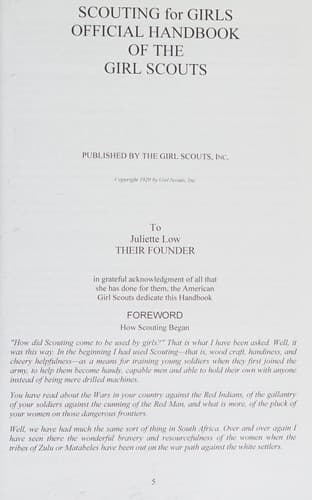
Scouting For Girls, Official Handbook of the Girl ScoutsGirl Scouts of the United States of America
History
Scouting For Girls, Official Handbook of the Girl Scouts
Girl Scouts of the United States of America
Girl Scouts -- Handbooks, manuals, etc.
Another measure for longer lengths is the distance from the end of your
nose, when your head is turned sharply to one side, to the end of your
thumb when your arm is stretched straight out from the shoulder in the
opposite direction. Measure and find out this distance for yourself by
holding the very end of a ribbon, tape or rope with the left hand to the
end of the nose, head turned to the left, and with the right hand run
the fingers along the edge of the ribbon until it is stretched to arm's
length. Marking the ribbon with a pin where the right thumb and
forefinger have held it, measure the distance with a yard measure or
rule from the end of the ribbon to the pin. This length will be about
the same as the standard unit of length used in this country. When
measuring a long length of goods, use the point held by the right hand
as the starting point to be held by left hand.
If you know the distance between the end of your little finger and the
end of your thumb when they are stretched apart, the palm of the hand
being flat, you can measure a distance such as the length of a table,
shelf, pole, etc. When judging the height of a person, remember that the
distance from the top of the head to the chin is about one-ninth of the
height of the body. The distance between the middle fingers when the
arms are stretched straight out from the shoulders is about equal to the
height of the body.
Another personal measure that is of value is the length of one's average
pace or stride; that is, the distance from the toe of one boot to the
toe of the other when walking a natural gait. It is also useful to know
the average number of paces taken in walking a given distance, such as a
mile, and the time required to make them. All of this information can be
obtained in a very simple way. Measure off as accurately as possible 220
yards, which is one-eighth of a mile, or take a known distance, and
pace it back and forth at least eight times, but not all in one day.
Each time keep a record of the number of paces taken and the time
required to pace the distance. Divide the sum of the paces by the number
of times paced and the result will be the average number of paces for
the distance. Then divide the whole distance by the average number of
paces and get the average length of your pace. Divide the sum of the
minutes spent in pacing the distance by the number of times paced, and
get the average length of time required to walk the distance. When the
average length of pace is known, the distance between two points can be
quite accurately estimated by pacing, if the ground is open, level and
solid. If up or down grade, if the ground is muddy or heavy, or there
are other causes which retard the gait, a reduction must be made.
None of the above methods for measuring are scientific, therefore are
not accurate, but they are useful ways of measuring _approximately_
lengths and distances by means of a guide always at hand.
2. MAP MAKING FOR GIRL SCOUTS
Public-domain text, read in full here on John Shaqi.
Reviews
Reviews
No reviews yet
Be the first to share your thoughts on this work.
Elsewhere in the archive
Join the Discussion
Join the discussion
Sign in to leave a comment or review.
Sign InorCreate an account