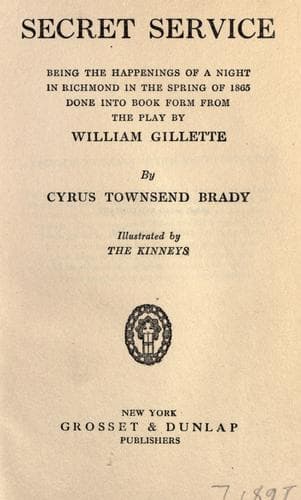
Secret Service: Being the Happenings of a Night in Richmond in the Spring of 1865Brady, Cyrus Townsend
History
Secret Service: Being the Happenings of a Night in Richmond in the Spring of 1865
Brady, Cyrus Townsend
Richmond (Va.) -- Fiction; Virginia -- History -- Civil War, 1861-1865 -- Fiction; War stories
Now Edith Varney had scarcely moved. She had expected nothing, she had
hoped for nothing, from the advent of the General. At best it would mean
only a little delay. The verdict was just, the sentence was adequate,
and the punishment must and would be carried out. She had listened,
scarcely apprehending, busy with her own thoughts, her eyes fastened on
Thorne, who stood there so pale and composed. But at this remarkable
statement by General Randolph she was suddenly quickened into life. A
low exclamation broke from her lips. A hope, not that his life might be
saved, but that it might be less shameful to love him, came into her
heart. Wilfred stepped forward also.
The terse statement of the General had caused a great deal of excitement
and commotion in the room. Only Thorne preserved his calmness. He was
glad that Edith Varney had learned this, and he was more glad that she
had learned it from the lips of the enemy, but it would make no
difference in his fate. He was not guilty of that particular charge, but
there were dozens of other charges for which they could try him, the
punishment of any one of which was death. Besides, he was a spy caught
in the Confederate lines, wearing a uniform not his own. It was enough
that the woman should learn that he had not taken advantage of her
action; at least she could not reproach herself with that.
“Why, General,” began Arrelsford, greatly dismayed, “I hardly understand
what you mean. That despatch—I saw him myself——”
General Randolph turned on him quickly.
“I say that that despatch was not sent,” he roared, striking the table
with his hand. “I expected to arrive in time for the trial. There is one
here who can testify. Lieutenant Foray?”
From among the group of staff officers who had followed General
Randolph, Lieutenant Foray stepped forward before the General and
saluted.
“Did Captain Thorne send out that despatch after we left you with him in
the office an hour ago?” asked the older officer.
“No, sir,” answered Foray promptly, glancing from Arrelsford’s thwarted
and flushed and indignant countenance to Edith Varney’s face, in which
he saw the light of a great illumination was shining. “No, sir,” he
repeated; “I was just about to send it by his orders, when he
countermanded it and tore up the despatch.”
“And what despatch was it?”
“It was one signed by the Secretary of War, sir, removing Marston’s
Division from Cemetery Hill.”
“You hear, gentlemen,” said the General, and, not giving them time to
answer, he turned again to Foray. “What were Captain Thorne’s words at
the time?”
“He said he refused to act under that commission, and crumpled it up and
threw it away.”
Public-domain text, read in full here on John Shaqi.
Reviews
Reviews
No reviews yet
Be the first to share your thoughts on this work.
Elsewhere in the archive
Join the Discussion
Join the discussion
Sign in to leave a comment or review.
Sign InorCreate an account