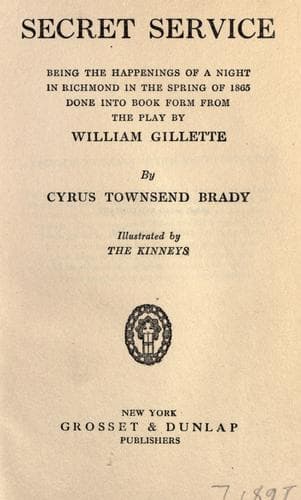
Secret Service: Being the Happenings of a Night in Richmond in the Spring of 1865Brady, Cyrus Townsend
History
Secret Service: Being the Happenings of a Night in Richmond in the Spring of 1865
Brady, Cyrus Townsend
Richmond (Va.) -- Fiction; Virginia -- History -- Civil War, 1861-1865 -- Fiction; War stories
“You can give us your answer later,” said the General.
“You have it now.”
“You will be kept in close confinement until you come to our terms,”
continued the older officer.
“You make me a prisoner for life, then.”
“You will see it in another light before many days, and it wouldn’t
surprise me if Miss Varney had something to do with a change in your
views.”
“You are mistaken, General Randolph,” quickly interposed Edith. “I think
he is perfectly right.”
“Oh, very well,” said the General, smiling a little. “We will see what a
little prison life will do. Sergeant?”
“Yes, sir.”
“I have turned the prisoner over to Major Whitfield. He requests you to
take the prisoner to his office, where he’ll take charge of him.”
“Very good, sir,” answered the Sergeant.
“What is it?” whispered Thorne to Edith. “Love and good-bye?”
“No,” answered the girl; “only the first.” She stopped and looked up at
him, her face flushed, her heart throbbing, her eyes shining gloriously.
“And that every day, every hour, every minute, until we meet again.”
“Thank God,” whispered Thorne. “Until we meet again.”
“Attention!” cried the Sergeant. “Carry arms! Left face! Fall in the
prisoner! Forward—March!”
AFTERWORD
And so the great adventure is over, the story is told, and the play is
played. It is hard to tell who lost and who won. It made little
difference in the end that Marston’s Division had not been withdrawn,
and that the attack on Cemetery Hill had failed. It made little
difference in the end that Arrelsford had been thwarted in his attempts
to wreak his vengeance upon Thorne. It made little difference in the end
that Thorne refused to enter the service of the Confederacy, preferring
imprisonment for life. For the days of that Confederacy were numbered.
It was even then tottering on the verge of its grave, in spite of the
brave front it kept up.
Three days after the events of that night, and Richmond had fallen, and
presently the last of the Confederate defenders halted at Appomattox.
The Stars and Bars were hauled down for the last time. The Army was
disbanded. The prisoners were released. There was a quiet wedding in the
old house. Howard, happily recovering from his wounds, was present.
General Varney himself gave away the bride—reluctantly, to be sure, yet
he did it. Wilfred took the place of the brother of Captain Thorne—to
continue to call him by the name he had assumed—and acted as the best
man. To whom should be given the coveted privilege of attending the
bride but to Miss Caroline Mitford! And Miss Kittridge and the few other
guests, including General Randolph, saw in the younger couple
indications that when a few more years had made it suitable, the two who
played the second part on this interesting occasion would be principals
themselves.
Public-domain text, read in full here on John Shaqi.
Reviews
Reviews
No reviews yet
Be the first to share your thoughts on this work.
Elsewhere in the archive
Join the Discussion
Join the discussion
Sign in to leave a comment or review.
Sign InorCreate an account