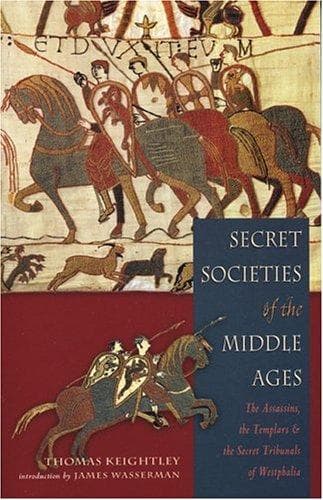
Secret Societies of the Middle AgesKeightley, Thomas
History
Secret Societies of the Middle Ages
Keightley, Thomas
Secret societies
In the second year of his reign Jellal-ed-deen gave a further proof of
the purity of his religious faith by permitting, or, perhaps, directing,
his harem, that is, his mother, his wife, and a long train of their
female attendants, to undertake the pilgrimage to the holy city of
Mecca, to worship at the tomb of the Prophet. The sacred banner was,
according to custom, borne before the caravan of the pilgrims from
Alamoot, and the Tesbeel, or distribution of water to the pilgrims,
usual on such occasions[58], was performed by the harem of the
mountain-prince on such a scale of magnificence and liberality as far
eclipsed that of the great Shah of Khaurism, whose caravan reached
Bagdad at the same time on its way to Mecca. The khalif
Nassir-ladin-Illah even gave precedence to the banner of the pilgrims
from Alamoot, and this mark of partiality drew on him the wrath of the
potent prince of Khaurism. Twice did the latter afterwards collect an
army to make war on the successor of the Prophet. With the first,
consisting of nearly 300,000 men, he marched against Bagdad, and had
reached Hamadan and Holuan, when a violent snow-storm obliged him to
retire. He had collected his forces a second time, when the hordes of
Chinghis Khan burst into his dominions. His son and successor resumed
his plans, and reached Hamadan, when again a snow-storm came to avert
destruction from the City of Peace. As the power of the Mongol conqueror
was now great and formidable, the prudent prince of Alamoot sent in
secret ambassadors to assure him of his submission, and to tender his
homage.
[Footnote 58: "Sebil, in Arabic 'the way,' means generally the road, and
the traveller is hence called _Ibn-es-sebil_, the son of the road; but
it more particularly signifies the way of piety and good works, which
leads to Paradise. Whatever meritorious work the Moslem undertakes, he
does _Fi sebil Allah_, on the way of God, or for the love of God; and
the most meritorious which he can undertake is the holy war, or the
fight for his faith and his country, _on God's way_. But since pious
women can have no immediate share in the contest, every thing which they
can contribute to the nursing of the wounded, and the refreshment of the
exhausted, is imputed to them as equally meritorious as if they had
fought themselves. The distribution of water to the exhausted and
wounded warriors is the highest female merit in the holy war on God's
way."--_Hammer's History of the Assassins_, Wood's translation, p. 144.]
Public-domain text, read in full here on John Shaqi.
Reviews
Reviews
No reviews yet
Be the first to share your thoughts on this work.
Elsewhere in the archive
Join the Discussion
Join the discussion
Sign in to leave a comment or review.
Sign InorCreate an account