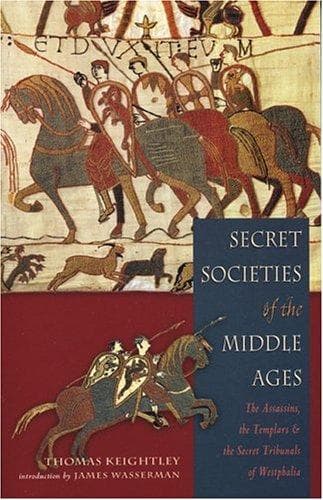
Secret Societies of the Middle AgesKeightley, Thomas
History
Secret Societies of the Middle Ages
Keightley, Thomas
Secret societies
The mountain range named Demavend, on the south side of which Roodbar,
the territory of the Ismaïlites, lies, is the northern termination of
the province of Irak Ajemee, or Persian Irak. Beyond it stretches to the
Caspian Sea a fertile region, partly hilly, partly plain[59]. This
country is divided into five districts, which were in those times
distinct from and independent of each other. At the foot of the
mountains lay Taberistan and Dilem, the former to the east, the latter
to the west. Dilem is celebrated as having been the native country of
the family of Buyah, which, rising from the humblest station, exercised
under the khalifs, and with the title of Ameer-al-Omra (_Prince of the
Princes_), a power nearly regal over Persia during a century and a
half[60]. North of Dilem lay Ghilan, and north of Taberistan Mazenderan,
the ancient Hyrcania. In the midst of these four provinces lay Ruyan
and Rostemdar, remarkable for having been governed for a space of 800
years by one family of princes, while dynasty after dynasty rose and
fell in the neighbouring states. In these provinces the names of the
royal lines recall to our mind the ancient history, both true and
fabulous, of Irân (Persia), as we find it in the poem of Ferdoosee, the
Homer of that country. The family of Kawpara, which governed Ruyan and
Rostemdar, affected to derive their lineage from the celebrated
blacksmith Gavah, who raised his apron as the standard of revolt against
the Assyrian tyrant Zohak; and the family of Bavend, which ruled for
nearly seven centuries, with but two interruptions, over Mazenderan and
Taberistan, were descended from the elder brother of Noosheerwan the
Just, the most celebrated monarch of the house of Sassan.
[Footnote 59: This part of Persia also acquires interest from the
circumstance of Russia being believed to be looking forward to obtaining
it, one day or other, by conquest or cession.]
[Footnote 60: Azed-ud-dowlah, one of the most celebrated of these
princes, had a dyke constructed across the river Kur, in the plain of
Murdasht, near the ruins of Persepolis, to confine the water, and permit
of its being distributed over the country. It was called the Bund-Ameer
(_Prince's Dyke_), and travellers ignorant of the Persian language have
given this name to the river itself. We must not, therefore, be
surprised to find in "Lalla Rookh" a lady singing,
"There's a bower of roses by Bendameer's _stream_;"
and asking,
"Do the roses still bloom by the _calm_ Bendameer?"
Calm and still, beyond doubt, is the Bendameer. ]
Public-domain text, read in full here on John Shaqi.
Reviews
Reviews
No reviews yet
Be the first to share your thoughts on this work.
Elsewhere in the archive
Join the Discussion
Join the discussion
Sign in to leave a comment or review.
Sign InorCreate an account