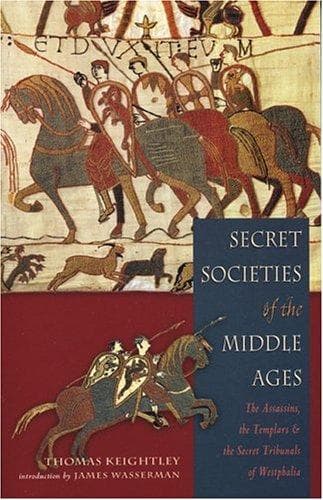
Secret Societies of the Middle AgesKeightley, Thomas
History
Secret Societies of the Middle Ages
Keightley, Thomas
Secret societies
Kej Kaoos, we are afterwards told by the poet, formed the insane project
of ascending to heaven, which he attempted in the following manner. A
stage was constructed on which a throne was set for the monarch; four
javelins were placed at the corners, with pieces of goat's flesh on
them, and four hungry eagles were tied at the bottom, who, by their
efforts to reach the meat, raised the stage aloft into the air; but when
the strength of the birds was exhausted the whole fell with the royal
aëronaut in the desert, where he was found by Roostem and the other
chiefs.
[Illustration: From the Same.]
The history of the Shah-nameh (_King-book_), in which these legends are
contained, is one of the most curious in literature. The fanaticism of
the Arabs, who conquered Persia, raged with indiscriminate fury against
the literature, as well as the religion, of that country; and when, in
the time of Al-Mansoor and his successors Haroon-er-Rasheed and
Al-Mamoon, the Arabs themselves began to devote their attention to
literature and science, it was the science of Greece and the poetry of
their native language that they cultivated. The Persian literature
meantime languished in obscurity, and the traditional, heroic, and
legendary tales of the nation were fading fast from memory, when a
governor of a province, zealous, as it would appear, for the honour of
the Persian nation, made a collection of them, and formed from them a
continuous narrative in prose. The book thus formed was called the
Bostan-nameh (_Garden-book_). It was in great repute in the northern
part of Persia, where, at a distance from the court of the khalifs, the
Persian manners, language, and nationality were better preserved; and
when the Turkish family of the Samenee founded an empire in that part of
Persia, sultan Mansoor I., of that race, gave orders to a poet named
Dakeekee to turn the Bastan-nameh into Persian verse. The poet undertook
the task, but he had not made more than a thousand verses when he
perished by assassination. There being no one supposed capable of
continuing his work, it was suspended till twenty years afterwards, when
the celebrated Mahmood of Ghizni, the conqueror of India, meeting with
the Bastan-nameh, gave portions of it to three of the most renowned
poets of the time to versify. The palm of excellence was adjudged to
Anseri, who versified the tale of Sohrab slain by his own father
Roostem, one of the most pathetic and affecting narratives in any
language. The sultan made him Prince of the Poets, and directed him to
versify the entire work; but, diffident of his powers, Anseri shrank
from the task, and having some time afterwards met a poet of Toos in
Khorasan, named Isaac, the son of Sheriff-Shah, surnamed Ferdoosee
(_Paradisal_[62]), either from his father's employment as a gardener, or
from the beauty of his verses, he introduced him to the sultan, who
gladly committed the task to him. Ferdoosee laboured with enthusiasm in
Public-domain text, read in full here on John Shaqi.
Reviews
Reviews
No reviews yet
Be the first to share your thoughts on this work.
Elsewhere in the archive
Join the Discussion
Join the discussion
Sign in to leave a comment or review.
Sign InorCreate an account