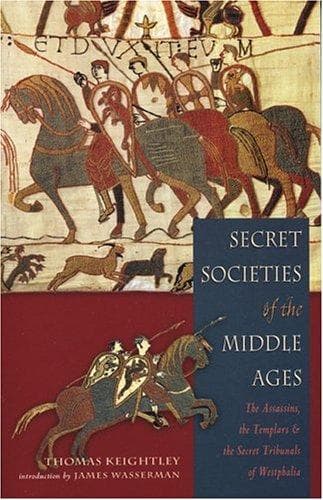
Secret Societies of the Middle AgesKeightley, Thomas
History
Secret Societies of the Middle Ages
Keightley, Thomas
Secret societies
The astronomer Nasir-ed-deen was not the only involuntary captive of
Alamoot. Ala-ed-deen sent once to Farsistan to the atabeg
Mozaffer-ed-deen, to request that he would send him an able physician.
Requests from Alamoot were not lightly to be disregarded, and the atabeg
despatched the imam Beha-ed-deen, one of the most renowned physicians of
the time, to the mountains of Jebal. The skill of the imam proved of
great benefit to the prince, but when the physician applied for leave to
return to his family he found that he was destined to pass the
remainder of his days in Alamoot, unless he should outlive his patient.
The imam's release, however, was more speedy than he expected.
Ala-ed-deen, who had several children, had nominated the eldest of them,
Rukn-ed-deen (_Support of Religion_), while he was yet a child, to be
his successor. As Rukn-ed-deen grew up the people began to hold him in
equal respect with his father, and to consider his commands as equally
binding on them. Ala-ed-deen took offence, and declared that he would
give the succession to another of his children; but, as this directly
contravened one of the Ismaïlite maxims, namely, that the first
nomination was always the true one, it was little heeded. Rukn-ed-deen,
in apprehension for his life, which his father threatened, retired to a
strong castle to wait there the time when he should be called to the
succession. Meantime the tyranny and caprice of Ala-ed-deen had given
many of the principal persons about him cause to be apprehensive for
their lives, and they resolved to anticipate him. There was a man at
Alamoot named Hassan, a native of Mazenderan, who, though no Ismaïlite,
was of a vile and profligate character. He was the object of the doating
attachment of Ala-ed-deen, and consequently had free and constant access
to him. Him they fixed upon as their agent, and they found no difficulty
in gaining him. Ala-ed-deen, whose fondness for breeding and tending
sheep had never diminished, had built for himself a wooden house close
by his sheep-cotes, whither he was wont to retire, and where he indulged
himself in all the excesses in which he delighted. Hassan of Mazenderan
seized the moment when Ala-ed-deen was lying drunk in this house, and
shot him through the neck with an arrow. Rukn-ed-deen, who is said to
have been engaged in the conspiracy, assuming the part of the avenger
of blood, the murderer and all his family were put to death, and their
bodies committed to the flames; but this act of seeming justice did not
free Rukn-ed-deen from suspicion, and the bitter reproaches of his
mother were poured forth on him as a parricide.
The termination of the power of the Ismaïlites was now at hand.
Rukn-ed-deen had hardly ascended the throne of his murdered father when
he learned that an enemy was approaching against whom all attempts at
resistance would be vain.
Chapter XI.
Public-domain text, read in full here on John Shaqi.
Reviews
Reviews
No reviews yet
Be the first to share your thoughts on this work.
Elsewhere in the archive
Join the Discussion
Join the discussion
Sign in to leave a comment or review.
Sign InorCreate an account