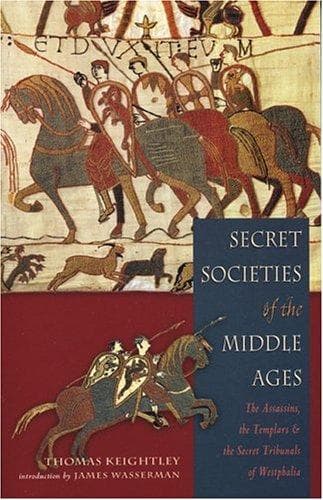
Secret Societies of the Middle AgesKeightley, Thomas
History
Secret Societies of the Middle Ages
Keightley, Thomas
Secret societies
At the present day, nearly six centuries after the destruction of the
Ismaïlite power, the sect is still in existence both in Persia and in
Syria. But, like that of the Anabaptists, it has lost its terrors, and
the Ismaïlite doctrine is now merely one of the speculative heresies of
Islam. The Syrian Ismaïlites dwell in eighteen villages around Massyat,
and pay an annual sum of 16,500 piastres to the governor of Hama, who
nominates their sheikh or emir. They are divided into two sects or
parties, the Sooweidanee, so named from one of their former sheikhs, and
the Khisrewee, so called on account of their great reverence for Khiser,
the guardian of the Well of Life. They are all externally rigid
observers of the precepts of Islam, but they are said to believe in the
divinity of Ali, in the uncreated light as the origin of all things, and
in the sheikh Rasheed-eddeen Sinan as the last representative of God
upon earth.
The Persian Ismaïlites dwell chiefly in Roodbar, but they are to be met
all over the east, and even appear as traders on the banks of the
Ganges. Their imam, whose pedigree they trace up to Ismaïl, the son of
Jaaffer-es-Sadik, resides, under the protection of the Shah of Persia,
at the village of Khekh, in the district of Koom. As, according to their
doctrine, he is an incarnate ray of the Divinity, they hold him in the
utmost veneration, and make pilgrimages from the most distant places to
obtain his blessing.
We have thus traced the origin, the growth, and the decline of this
formidable society, only to be paralleled by that of the Jesuits in
extent of power and unity of plan and purpose. Unlike this last,
however, its object was purely evil, and its career was one of blood: it
has therefore left no deeds to which its apologists might appeal in its
defence. Its history, notwithstanding, will always form a curious and
instructive chapter in that of the human race.
THE TEMPLARS.
CHAPTER I.
Introduction--The Crusades--Wrong Ideas respecting their
Origin--True Causes of them--Pilgrimage--Pilgrimage of Frotmond--Of
the Count of Anjou--Striking Difference between the Christianity of
the East and that of the West--Causes of their different
Characters--Feudalism--The Extent and Force of this Principle.
Public-domain text, read in full here on John Shaqi.
Reviews
Reviews
No reviews yet
Be the first to share your thoughts on this work.
Elsewhere in the archive
Join the Discussion
Join the discussion
Sign in to leave a comment or review.
Sign InorCreate an account