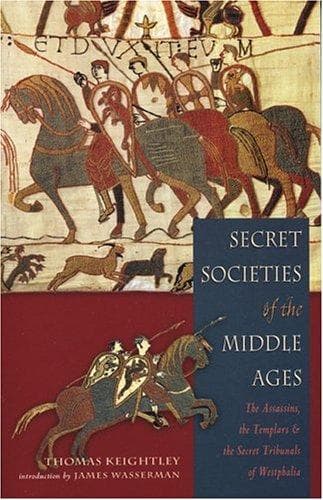
Secret Societies of the Middle AgesKeightley, Thomas
History
Secret Societies of the Middle Ages
Keightley, Thomas
Secret societies
The year 1162 is conspicuous in the annals of the Templars, as the date
of the bull _Omne Datum Optimum_, the Magna Charta of the order, and the
great key-stone of their power. On the death of Adrian IV. two rival
popes were elected,--Alexander III. by the Sicilian,--Victor III. by the
Imperial party. The Templars at first acknowledged the latter; but at a
synod, held at Nazareth, in 1161, they took the side of his rival.
Alexander, who came off victor, was not ungrateful; and on the 7th
January, of the following year, the aforesaid bull was issued. By this
document, which would almost appear to be the dictation of the order,
the Templars were released from all spiritual obedience except to the
Holy See; they were allowed to have peculiar burial-grounds at their
houses, and to have chaplains of their own; they were freed from the
obligation to pay tithes, and could, with the consent of the bishop,
receive them. It was also prohibited to any one who had once entered the
order, to leave it, unless it were to enter into a stricter one. These
great privileges necessarily awakened the envy and enmity of the clergy
against the Templars and the Hospitallers, which last were equally
favoured by the pontiffs; but these artful prelates, who were now aiming
at universal power, knew well the advantage which they might derive from
attaching firmly to them these associations, which united the valour of
the knight to the obedience of the monk, whose members were of the
noblest families in Europe, and whose possessions were extensive and
spread over all parts of the Christian world.
In 1167 occurred one of the few instances of cowardice, or rather, we
might say, treachery, which the annals of the Templars present. Almeric,
king of Jerusalem, had committed to the Templars the charge of guarding
one of those strong fortified caverns which were on the other side of
the Jordan. Here they were besieged by the Turks, and, though the king
was hastening to their relief, they capitulated. Almeric, incensed at
their conduct, though he was a great friend of the order, and
particularly of the Master, Philip of Naploos, instantly had twelve of
the cowardly or treacherous knights hanged, and he experienced no
opposition whatever on the part of the order. Philip, we may observe,
was the first Master of the Temple who was a born Syrian; but he appears
to have been a man of fair and honourable character. He was lord of the
fortresses of Krak and Montreal in the Stony Arabia, which he had
obtained with his wife. It was not till after her death that he became a
Templar. Alter holding the dignity of Master for three years he resigned
it. The cause of his resignation is unknown; but he was highly honoured
and respected during the remainder of his life, and was employed on
various important occasions.
Public-domain text, read in full here on John Shaqi.
Reviews
Reviews
No reviews yet
Be the first to share your thoughts on this work.
Elsewhere in the archive
Join the Discussion
Join the discussion
Sign in to leave a comment or review.
Sign InorCreate an account