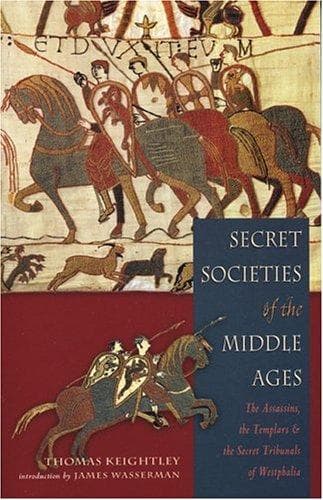
Secret Societies of the Middle AgesKeightley, Thomas
History
Secret Societies of the Middle Ages
Keightley, Thomas
Secret societies
The hostility between the Templars and the Hospitallers still continued,
though the Christian power was now nearly restricted to the walls of
Acre. The Templars were in alliance with the prince of Damascus: the
Hospitallers were the friends of the sultan of Egypt. The Templars
extended their enmity against the emperor to the Teutonic knights, whom
they deprived of their possessions in Syria. The appearance of a new
enemy, however, brought concord for a time among them. The Turks of
Khaurizm, on the east of the Caspian, were now in flight before the
hordes of the Mongols, and 20,000 of their horsemen burst into the Holy
Land. They took and plundered Jerusalem, which was unfortified and open,
and then united themselves with the troops of Egypt. The Christians
applied to the prince of Damascus for aid, who forthwith sent the
required troops, and their combined forces went in quest of the foes. In
the battle the Templars and the militia occupied the centre; the
Hospitallers were posted on the left wing, the light horse on the right.
The battle lasted two days, and ended in the total defeat of the
Christians, a result which is ascribed, though probably with injustice,
to the treachery of the Damascenes. The Master of the Temple and the
whole chapter, with the knights, in all 300, were slain; only four
knights and fourteen esquires escaped.
The improvident and needy Henry III. of England, in general such a
dutiful son of the holy father, who, for a share of the spoil, usually
aided him in the pious work of robbing his subjects, summoned courage in
1252 to speak of seizing some of the property of the church and the
military orders. "You prelates and religious," said he, "especially you
Templars and Hospitallers, have so many liberties and charters, that
your enormous possessions make you rave with pride and haughtiness. What
was imprudently given, must be therefore prudently revoked; and what was
inconsiderately bestowed must be considerately recalled.... I will break
this and other charters which my predecessors and myself have rashly
granted." But the prior of the Templars immediately replied, "What
sayest thou, O king? Far be it that thy mouth should utter so
disagreeable and silly a word. So long as thou dost exercise justice
thou wilt reign; but if thou infringe it, thou wilt cease to be a king!"
These bold words appear to have checked the feeble king, who next year
besought the two orders to become his security for a large sum of money
which he owed. They refused his request, and Henry thenceforth did them
all the injury in his power.
Public-domain text, read in full here on John Shaqi.
Reviews
Reviews
No reviews yet
Be the first to share your thoughts on this work.
Elsewhere in the archive
Join the Discussion
Join the discussion
Sign in to leave a comment or review.
Sign InorCreate an account