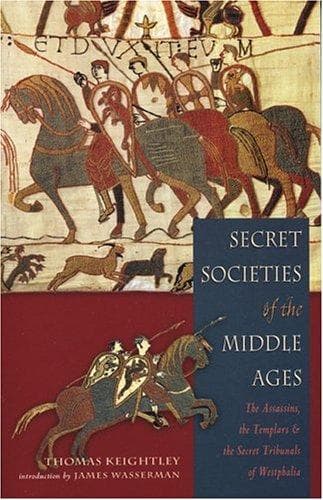
Secret Societies of the Middle AgesKeightley, Thomas
History
Secret Societies of the Middle Ages
Keightley, Thomas
Secret societies
From this period till the capture of Acre and final destruction of the
Latin power in the East in 1291, after a continuance of nearly two
centuries, the annals of the Templars are bare of events. The rivalry
between them and the other orders still continued; and in the opinion of
some historians, it was their jealousy that hastened the fall of that
last remnant of the Christian dominion in the East. Not more than ten
knights of the Temple escaped in the storm of the town, and these, with
the remnants of the other orders, and the garrison, sought a retreat in
Cyprus.
We have now traced the history of the order from its institution to
within a few years of the period of its suppression. Of this most
important event we shall delay the consideration for some time, and
shall occupy the intervening space with an account of the internal
organisation of the society, its officers, its wealth, and various
possessions. This will, we trust, prove no slight contribution to our
knowledge of one of the most curious portions of the history of the
world--that of the middle ages--and gratify the reader by the display of
manners and institutions which have long since passed away[78].
[Footnote 78: The organisation and the rules of the Hospitallers were
similar to those of the Templars; but as that order existed down to
modern times, the rules, &c., given by Vertot, contain a great number of
modern additions.]
CHAPTER V.
Classes of the Templars--The Knights--Their Qualifications--Mode of
Reception--Dress and Arms of the Knight--Mode of Burial--The
Chaplains--Mode of Reception--Dress--Duties and Privileges--The
Serving-Brethren--Mode of Reception--Their Duties--The
Affiliated--Causes and Advantages of Affiliation--The Donates and
Oblates.
The founders of the order of the Templars were, as we have seen,
knights; and they were the first who conceived the novel idea, and happy
one, as we may call it in accordance with the sentiments of those times,
of uniting in the same person the two characters held in highest
estimation--the knight and the monk. The latter added sanctity to the
former, the former gave dignity and consideration to the latter, in the
eyes of a martial generation. Hence, the Templar naturally regarded
himself as the first of men; and the proudest nobles of the Christian
world esteemed it an honour to belong to the order. The knights were,
therefore, the strength, the flower, the ornament of the society.
The order of the Templars, when it was fully developed, consisted not of
_degrees_, but of distinct and separate _classes_. These were the
knights, the chaplains, and the serving-brethren; to which may be added
the affiliated, the donates, and the oblates, or persons attached to the
order without taking the vows.
Public-domain text, read in full here on John Shaqi.
Reviews
Reviews
No reviews yet
Be the first to share your thoughts on this work.
Elsewhere in the archive
Join the Discussion
Join the discussion
Sign in to leave a comment or review.
Sign InorCreate an account