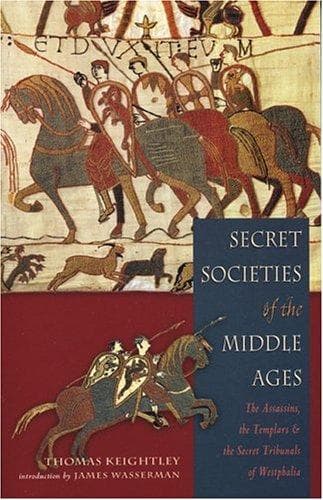
Secret Societies of the Middle AgesKeightley, Thomas
History
Secret Societies of the Middle Ages
Keightley, Thomas
Secret societies
A noviciate forms an essential and reasonable part of the course of
admission into the spiritual orders in general; for it is but right that
a person should become, in some measure, acquainted with the rules and
duties of a society before he enters it. But, though the original rule
of the Templars enjoined a noviciate, it was totally neglected in
practice; a matter which was afterwards made one of the charges against
the order. Perhaps there was in their case little necessity for this
preparatory process; the Templars were so much in the world, and those
who joined them had been in general so frequently among them, and were
consequently so well acquainted with their mode of life, that they
hardly required any such preliminary discipline to familiarize them with
their duties. The neglect of the practice at the same time gave the
Templars an advantage over the rival orders who enjoined it; for a young
nobleman would, in all likelihood, feel most disposed to join the
society into which he could be admitted at once; and perhaps no small
part of the corruption of the Templars, in which they undoubtedly
surpassed their rivals, may be ascribed to the facility which was thus
afforded to unworthy persons entering among them.
With respect to the age at which persons were admitted, it is plain,
from the previously required reception of knighthood, that it must have
been that of adolescence or manhood. All that is said by the statutes
is, that no child could be received; and that the parents or relatives
of a child destined to be a member of the order, should keep and breed
him till _he could manfully and with armed hand extirpate the enemies of
Christ out of the land_. This formed a marked distinction between the
Templars and the mere religious orders, who, even at the present day, we
believe, admit children, taking the charge of their rearing and
education; whereas, children could only be destined to the order of the
Temple, and could not be presented for admission, till able to bear
arms, that is, usually in the twenty-first year of their age.
The reception of a knight took place in one of the chapels of the order,
in presence of the assembled chapter. It was secret, not even the
relatives of the candidate being allowed to be present. The ceremony
commenced by the Master[79] or prior, who presided, saying, "Beloved
brethren, ye see that the majority are agreed to receive this man as a
brother. If there be any among you who knows any thing of him, on
account of which he cannot lawfully become a brother, let him say it;
for it is better that this should be signified beforehand than after he
is brought before us."
[Footnote 79: When we use the word "Master," we would always be
understood to mean the Master or his representative.]
Public-domain text, read in full here on John Shaqi.
Reviews
Reviews
No reviews yet
Be the first to share your thoughts on this work.
Elsewhere in the archive
Join the Discussion
Join the discussion
Sign in to leave a comment or review.
Sign InorCreate an account