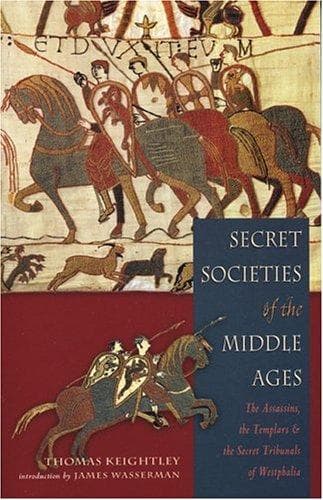
Secret Societies of the Middle AgesKeightley, Thomas
History
Secret Societies of the Middle Ages
Keightley, Thomas
Secret societies
When the Templar died, he was placed in a coffin in his habit, and with
his legs crossed, and thus buried. Masses were said for his soul; his
arms and clothes were partly given back to the marshal or draper of the
order--partly distributed among the poor.
II. The Chaplains.--The order of the Templars, being purely military in
its commencement, consisted then solely of laymen. That of the Hospital,
on the contrary, on account of its office of attending the sick, had,
necessarily, priests in it from its origin. This advantage of the latter
society excited the jealousy of the Templars, and they were urgent with
the popes to be allowed a similar privilege. But the pontiffs were loth
to give offence to the oriental prelates, already displeased at the
exemption from their control granted in this case to the Hospitallers;
and it was not till the year 1162, that is, four years after the
founding of the order, when their great favourer, Alexander III.,
occupied the papal throne, that the Templars attained their object.
[Illustration: Knights in Temple Church, London.]
The bull, _Omne Datum Optimum_, issued on this occasion, gave permission
to the Templars to receive into their houses spiritual persons, in all
countries, who were not bound by previous vows. If they were clergy of
the vicinity, they were to ask them of the bishop; and if he refused his
consent, they were empowered, by the bull, to receive them without it.
The clergy of the Temple were to perform a noviciate of a year--a
practice which, as in the case of the knights, was dispensed with in the
days of the power and corruption of the order. The reception of the
clergy was the same as that of the knights, with the omission of such
questions as did not apply to them. They were only required to take the
three vows of poverty, chastity, and obedience. The ritual of their
reception was in Latin, and was almost precisely the same with that of
the Benedictines. Like that of the knights, their reception was secret.
When the psalms had been sung the Master put on the recipient the dress
of the order and the girdle, and, if he was a priest, the cap called
_baret_.
[Illustration: Effigies of Knights in Temple Church.]
The habit of the chaplains of the order was a white close-fitting tunic,
with a red cross on the left breast. Though, according to the statutes,
they were to have the best clothes in the order, they were not permitted
to assume the white mantle as long as they were mere priests. But should
one of them, as was not unfrequently the case, arrive at the episcopal
dignity, he was, if desirous of it, cheerfully granted that privilege.
It was a further distinction between the knights and the chaplains, that
the former wore their beards, while the latter were close-shaven. The
chaplains were also to wear gloves, _out of respect to the body of the
Lord_.
Public-domain text, read in full here on John Shaqi.
Reviews
Reviews
No reviews yet
Be the first to share your thoughts on this work.
Elsewhere in the archive
Join the Discussion
Join the discussion
Sign in to leave a comment or review.
Sign InorCreate an account