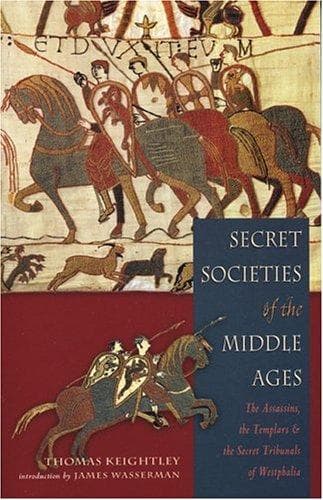
Secret Societies of the Middle AgesKeightley, Thomas
History
Secret Societies of the Middle Ages
Keightley, Thomas
Secret societies
The serving-brethren were originally all of one kind; they fought
in the field; they performed the menial offices in the houses of
the order; but, in after-times, we find them divided into two
classes--the brethren-in-arms (_Frères servons des armes_), and the
handicraft-brethren (_Frères servons des mestiers_). These last, who
were the least esteemed of the two, dwelt in the houses and on the lands
of the order, exercising their various trades, or looking after the
property of the society. We read in the statutes of the smiths and
bakers of the order, and we hear of _preceptors_ (as was the phrase) of
the mares, cows, swine, &c. of the order. These handicraft-brethren
practised the usual religious duties of the order, and were even allowed
to be present at chapters. The farrier, who was also armourer,
enjoyed a much higher degree of consideration than the other
handicraft-brethren, for this profession was highly prized by the
martial generation of the middle ages[82].
[Footnote 82: Sir W. Scott is perfectly correct in making the smith so
important a character in his St. Valentine's Eve.]
The other class were more highly regarded. The knights associated with
them on a footing of equality. They ate in the same refectory with the
knights and priests, although at separate tables, and with always one
dish less than the higher classes. They were, however, strictly
subordinate to the knights; the master and all the great officers of the
order had each several serving-brethren to attend him, and each knight
had some of the serving-brethren among his esquires. The statutes
provided carefully against their being tyrannized over or otherwise
ill-treated by the knights.
The statutes make a distinction between the serving-brethren who were
armed with iron and those who were not. The former were the proper
light-horse of the order; they were chiefly intended to support the
knights in the action, and were usually placed in the second rank. The
place of the unarmed was with the baggage; and as they were exposed to
little danger, they wore only linen corslets. The others were enjoined
to fight, without flinching, as long as a Christian banner flew on the
field: it was matter of praise to these last if they managed to come
safe out of the fight. When the troops of the Temple were on their
march, the esquires rode before the knights with their baggage. When the
knights were going to action, one esquire rode before each with his
lance, another behind with his war-horse.
There were various offices in the society, hereafter to be noticed,
which were appropriated to the serving-brethren, or to which they were
eligible.
Public-domain text, read in full here on John Shaqi.
Reviews
Reviews
No reviews yet
Be the first to share your thoughts on this work.
Elsewhere in the archive
Join the Discussion
Join the discussion
Sign in to leave a comment or review.
Sign InorCreate an account