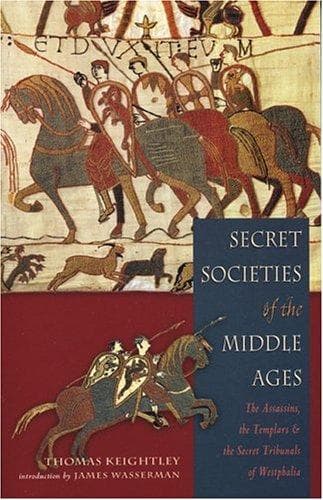
Secret Societies of the Middle AgesKeightley, Thomas
History
Secret Societies of the Middle Ages
Keightley, Thomas
Secret societies
We have thus seen what a number of persons of all ranks were more or
less intimately connected with the order of the Temple, and how powerful
its influence must have been throughout the Christian world. To enable
the reader to form some conception of its wealth and power, we shall,
previous to explaining its system of internal regulation, give a view of
its possessions in various countries.
The extensive possessions of the order of the Temple, in Asia and in
Europe, were divided into provinces, each containing numerous
preceptories or temple-houses, and each under its appointed governor.
These provinces may be classified under the heads of Eastern and
Western.
The eastern provinces of the order were,--
I. Jerusalem.--This province was always regarded as the ruling one; the
chief seat and capital of the order. The Master and chapter resided here
as long as the Holy City was in the hands of the Christians. This being
the province which was first established, its regulations and
organization served as a model for all others. Its provincial Master,
or, as he was styled, the Preceptor of the Land and Kingdom of
Jerusalem, took precedence of all others of the same rank.
The bailiwicks, or commanderies, in this province, were,--
1. The Temple of Jerusalem, the cradle of the order, and the original
residence of the Master and the chapter.
2. Chateau Pélerin, or the Pilgrim's Castle, renowned in the history of
the crusades. This castle was built by the Templars in 1217, in order
that it might be their chief seat after the loss of Jerusalem. It was
situated on the east side of Mount Carmel, which runs out into the sea
between Caipha and Cæsarea. The Templars had long had a tower at a pass
of this mountain, called _Destruction_, or the Tower of the Pass, for
the defence of pilgrims against the robbers who lurked in the gorges of
the mountains. They were aided in building the castle, which was also
designed to be a defence to Acre, by Walter D'Avesnes and by the German
knights and pilgrims who were at that time in the Holy Land, and hence,
perhaps, they called it Chateau Pélerin. The Cardinal de Vitry, who was
at that time bishop of Acre, thus describes it. It was built on the
promontory, three sides of which were washed by the sea. As they were
sinking the foundation, they came to two walls of ancient masonry, and
to some springs of remarkably pure water; they also found a quantity of
ancient coins with unknown inscriptions, given, as the bishop piously
deems, by God to his beloved sons and warriors, to alleviate the toil
and expense which they were at. The place had probably been fortified in
former times by the Jews or the Romans. The builders raised two huge
towers of large masses of rock on the landward side, each 100 feet high,
and 74 broad; these were united by a lofty wall, broad enough at its
summit for an armed knight to stand at his ease upon it. It had a
parapet and battlements, with steps leading up to them. In the space
Public-domain text, read in full here on John Shaqi.
Reviews
Reviews
No reviews yet
Be the first to share your thoughts on this work.
Elsewhere in the archive
Join the Discussion
Join the discussion
Sign in to leave a comment or review.
Sign InorCreate an account