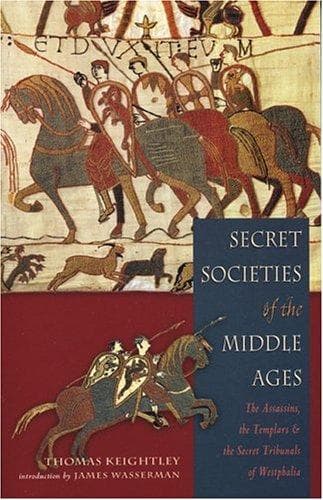
Secret Societies of the Middle AgesKeightley, Thomas
History
Secret Societies of the Middle Ages
Keightley, Thomas
Secret societies
beyond which, as it would appear, his plans did not at first extend. We
cannot venture to say when this project first entered the mind of king
Philip; whether he had the Hospitallers also in view, and whether he
impelled the pope to invite the Masters of the two orders to France.
As the rivalry and ill-feeling between the two orders had long been
regarded as one of the principal causes of the little success of the
Christians in the East, the idea of uniting them had been conceived, and
Gregory X. and St. Louis had striven, but in vain, at the council at
Lyons, to effect it. Pope Boniface VIII. had also been anxious to bring
this project to bear, and Clement now resolved to attempt it. On the 6th
June, 1306, only six months after his coronation, he wrote to the
Masters of the two orders to the following effect;--The kings of Armenia
and Cyprus were calling on him for aid; he therefore wished to confer
with them, who knew the country well, and were so much interested in it,
as to what were best to be done, and desired that they would come to him
as secretly as possible, and with a very small train, as they would find
plenty of their knights on this side of the sea; he directed them to
provide for the defence of Limisso during their absence.
The Master of the Hospital, William de Villaret, was, when the letter
arrived, engaged in the attack on Rhodes, and, therefore, could not obey
the summons. But De Molay, the Master of the Temple, having confided
Limisso and the direction of the order to the marshal, embarked with
sixty of his most distinguished knights, taking with him the treasure of
the order, consisting of 150,000 florins of gold, and so much silver,
that the whole formed the lading of twelve horses. When they arrived in
France, he proceeded to Paris, where the king received him with the
greatest marks of favour and distinction, and he deposited the treasure
in the Temple of that city. Shortly afterwards he set out for Poitiers,
where he had an interview with Clement, who consulted him on the affairs
of the East. On the subject of a new crusade, Molay gave it as his
opinion that nothing but a simultaneous effort of all the Christian
powers would be of any avail. He objected to the union of the orders on
the following grounds, which were, on the whole, sufficiently frivolous.
He said, 1st. That what is new is not always the best; that the orders,
as they were, had done good service in Palestine, and, in short, used
the good old argument of anti-reformists, _It works well_. 2dly. That as
the orders were spiritual as well as temporal, and many a one had
entered them for the weal of his soul, it might not be a matter of
indifference to such to leave the one which he had selected and enter
another. 3dly. There might be discord, as each order would want its own
wealth and influence, and seek to gain the mastery for its own rules and
discipline. 4thly. The Templars were generous of their goods, while the
Public-domain text, read in full here on John Shaqi.
Reviews
Reviews
No reviews yet
Be the first to share your thoughts on this work.
Elsewhere in the archive
Join the Discussion
Join the discussion
Sign in to leave a comment or review.
Sign InorCreate an account