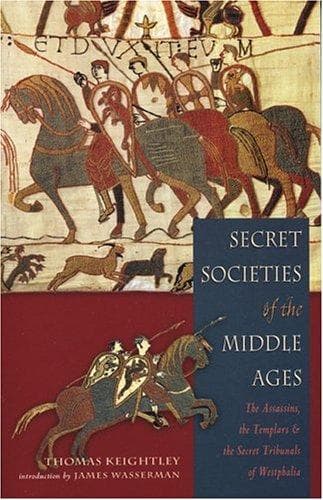
Secret Societies of the Middle AgesKeightley, Thomas
History
Secret Societies of the Middle Ages
Keightley, Thomas
Secret societies
At Paris the knights who confessed acknowledged the denial of Christ
(this was the point which the inquisitors were most anxious to
establish), but in an uncertain, contradictory manner, as what was said
on one examination was retracted on another, or was enlarged or
diminished. It was also confessed that an idol was adored in their
chapters. At Nîmes, in November, 1307, forty-five knights confessed the
guilt of the order. They afterwards retracted; but in 1311 the torture
made them revert to their original declaration. At Troyes two knights
confessed everything that was required of them. At Pont de l'Arche seven
confessed. These and six others were again examined at Caen; they
terminated their declarations by imploring the mercy of the Church, and
entreating with tears to be spared the torture. Those examined at
Carcassonne all deposed to the worship of the image; but some of them
afterwards retracted that admission, and died maintaining the innocence
of the order. Six Templars at Bigorre[97] and seven at Cahors confessed;
but several of them afterwards retracted.
[Footnote 97: In the church of the romantic hamlet of Gavarnic, a few
leagues from Barèges, on the road to Spain, in the heart of the Hautes
Pyrénées, are shown twelve skulls, which are said to have been those of
Templars who were beheaded in that place. The tradition is, in all
probability, incorrect; but the Templars had possessions in Bigorre.]
Philip and his creatures were at this stage of their career, when the
pope began to testify some little dissatisfaction at the irregularity of
the proceedings. The king instantly wrote to upbraid him with his
lukewarmness in the cause of religion. He stated that the bishops, who
were his (the king's) helpers in the government of the Church, were the
fittest persons to carry on the business, on account of their local
knowledge; and added that neither he nor they could comply with the
desires of the pope: "he acted," he said, "as the servant of God, and
must render to God his account." Clement could not venture to impede the
pious labours of such a zealous servant of the Lord; he cancelled the
bull which he had prepared on the subject, only requiring that each
bishop's inquisitors should be confirmed by a provincial council, and
that the examination of the heads of the order should be reserved for
himself. Philip then condescended to offer to put the captives into the
hands of the papal judges, and to devote the goods of the order to the
profit of the Holy Land. The clergy declined taking charge of the
knights, and the king and pope managed the property of the order in
common.
Public-domain text, read in full here on John Shaqi.
Reviews
Reviews
No reviews yet
Be the first to share your thoughts on this work.
Elsewhere in the archive
Join the Discussion
Join the discussion
Sign in to leave a comment or review.
Sign InorCreate an account