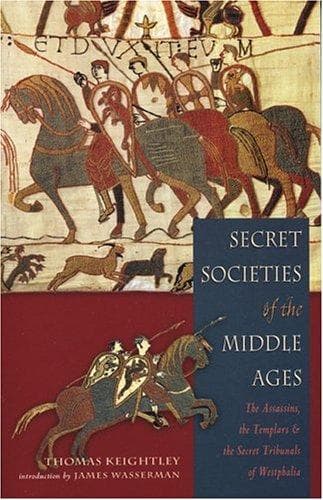
Secret Societies of the Middle AgesKeightley, Thomas
History
Secret Societies of the Middle Ages
Keightley, Thomas
Secret societies
"I declare then, on peril of my soul, and on the oath which I have
taken, that, at the time of my reception, I neither denied God nor spat
upon the cross, nor committed any of the indecencies of which we are
accused, and was not required so to do. It is true that I have made
confessions before the inquisitors; but it was through the fear of
death, and because Giles de Rotangi had, with tears, said to me, and
many others who were with me in prison at Montreuil, that we should pay
for it with our lives, if we did not assist by our confessions to
destroy the order. I yielded, and afterwards I wished to confess myself
to the Bishop of Amiens; he referred me to a Minorite friar; I accused
myself of this falsehood, and obtained absolution, on condition that I
would make no more false depositions in this affair. I tell you the
truth; I persist in attesting it before you; come what may of it, I
prefer my soul to my body."
Nothing can bear more plainly the character of truth than this
declaration; yet three days afterwards the witness came back, revoked it
all, spoke of the cat which used to appear in the chapters, and said
that, if the order had not been abolished, he would have quitted it. Had
he not been well menaced and tortured in the _interim_?
The examination of Peter de la Palu, a bachelor in theology of the order
of the preachers, the 201st witness, brought from him these remarkable
words: "I have been present at the examination of several Templars, some
of whom confessed many of the things contained in the said articles, and
some others totally denied them; and for many reasons it appeared to me
that greater credit was to be given to those who denied than to those
who confessed."
CHAPTER XI.
Examinations in England--Germany--Spain--Italy--Naples and
Provence--Sicily--Cyprus--Meeting of the Council of
Vienne--Suppression of the order--Fate of its Members--Death of
Molay.
The time fixed for the meeting of the council at Vienne was now at hand,
in which the fate of the order was to be decided. Before we proceed to
narrate its acts we will briefly state the result of the examinations of
the Templars in other countries.
The pope sent, as his judges, to England, Dieu-donné, abbot of Lagny,
and Sicard de Vaux, canon of Narbonne; and the examinations commenced at
York, London, Lincoln, and other places, on the 25th November, 1309. The
inquiry continued till the council held in London in 1311; the number of
Templars examined was two hundred and twenty-eight; that of the
witnesses against the order was seventy-two, almost all Carmelites,
Minorites, Dominicans, and Augustinians, the natural foes of the order.
The Templars were treated with great mildness; and in England, Ireland,
and Scotland, they were unanimous and constant in their assertion of the
innocence of the order. The evidence against the order was almost all
hearsay: its nature will be shown by the following specimens.
Public-domain text, read in full here on John Shaqi.
Reviews
Reviews
No reviews yet
Be the first to share your thoughts on this work.
Elsewhere in the archive
Join the Discussion
Join the discussion
Sign in to leave a comment or review.
Sign InorCreate an account