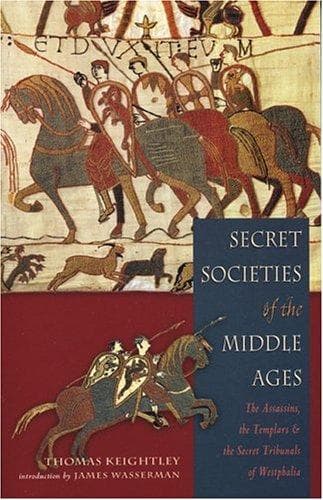
Secret Societies of the Middle AgesKeightley, Thomas
History
Secret Societies of the Middle Ages
Keightley, Thomas
Secret societies
Still it must be confessed that the origin of the Fehm-gerichte is
involved in the same degree of obscurity which hangs over that of the
Hanseatic league and so many other institutions of the middle ages; and
little hopes can be entertained of this obscurity ever being totally
dispelled. Conjecture will, therefore, ever have free scope of the
subject; and the opinion which we have just expressed ourselves as
inclined to adopt is only one of nine which have been already advanced
on it. Four of these carry back the origin of the Fehm-gerichte to the
time of Charlemagne, making them to have been either directly instituted
by that great prince, or to have gradually grown out of some of his
other institutions for the better governing of his states. A fifth
places their origin in the latter half of the eleventh century, and
regards them as an invention of the Westphalian clergy for forwarding
the views of the popes in their attempt to arrive at dominion over all
temporal princes. A sixth ascribes the institution to St. Engelbert,
Archbishop of Cologne, to whom the Emperor Frederic II. committed the
administration of affairs in Germany during his own absence in Sicily,
and who was distinguished for his zeal in the persecution of heretics.
He modelled it, the advocates of this opinion say, on that of the
Inquisition, which had lately been established. The seventh and eighth
theories are undeserving of notice. On the others we shall make a few
remarks.
The first writers who mention the Fehm-gerichte are Henry of Hervorden,
a Dominican, who wrote against them in the reign of the Emperor Charles
IV., about the middle of the fourteenth century; and Æneas Sylvius, the
secretary of Frederic III., a century later. These writers are among
those who refer the origin of the Fehm-gerichte to Charlemagne, and such
was evidently the current opinion of the time--an opinion studiously
disseminated by the members of the society, who sought to give it
consequence in the eyes of the emperor and people, by associating it
with the memory of the illustrious monarch of the West. There is,
however, neither external testimony nor internal probability to support
that opinion. Eginhart, the secretary and biographer of Charlemagne, and
all the other contemporary writers, are silent on the subject; the
valuable fragments of the ancient Saxon laws collected in the twelfth
century make not the slightest allusion to these courts; and, in fine,
their spirit and mode of procedure are utterly at variance with the
Carlovingian institutions. As to the hypothesis which makes Archbishop
Engelbert the author of the Fehm-gerichte, it is entirely unsupported by
external evidence, and has nothing in its favour but the coincidence, in
point of time, of Engelbert's administration with the first account
which we have of this jurisdiction, and the similarity which it bore in
the secrecy of its proceedings to that of the Holy Inquisition--a
Public-domain text, read in full here on John Shaqi.
Reviews
Reviews
No reviews yet
Be the first to share your thoughts on this work.
Elsewhere in the archive
Join the Discussion
Join the discussion
Sign in to leave a comment or review.
Sign InorCreate an account