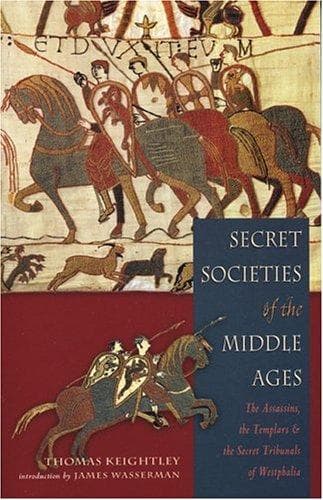
Secret Societies of the Middle AgesKeightley, Thomas
History
Secret Societies of the Middle Ages
Keightley, Thomas
Secret societies
Supposing the former course to have been chosen,--which was usually done
when the criminal had been taken in the fact, but had contrived to
escape, or when he was a man whom common fame charged openly and
distinctly with a crime,--he was not cited to appear before the court
or vouchsafed a hearing. He was usually denounced by one of the
initiated; the court then examined into the evidence of his guilt, and
if it was found sufficient he was outlawed, or, as it was called,
_forfehmed_[124], and his name was inscribed in the blood-book. A
sentence was immediately drawn out, in which all princes, lords, nobles,
towns, every person, in short, especially the initiated, were called
upon to lend their aid to justice. This sentence, of course, could
originally have extended only to Westphalia; but the Fehm-courts
gradually enlarged their claims; their pretensions were favoured by the
emperors, who regarded them as a support to their authority; and it was
soon required that their sentence should be obeyed all over the empire,
as emanating from the imperial power.
[Footnote 124: In German _Verfehmt_. We have ventured to coin the word
in the text. The English for answers to the German _ver_; _vergessen_ is
_forget_; _verloren_ is _forlorn_.]
Unhappy now was he who was _forfehmed_; the whole body of the initiated,
that is 100,000 persons, were in pursuit of him. If those who met him
were sufficient in number, they seized him at once; if they felt
themselves too weak, they called on their brethren to aid, and every one
of the society was bound, when thus called on by three or four of the
initiated, who averred to him on oath that the man was _forfehmed_, to
help to take him. As soon as they had seized the criminal they proceeded
without a moment's delay to execution; they hung him on a tree by the
road-side and not on a gallows, intimating thereby that they were
entitled to exercise their office in the king's name anywhere they
pleased, and without any regard to territorial jurisdiction. The halter
which they employed was, agreeably to the usage of the middle ages, a
_withy_; and they are said to have had so much practice, and to have
arrived at such expertness in this business, that the word _Fehmen_ at
last began to signify simply _to hang_, as _execution_ has come to do in
English. It is more probable, however, that this, or something very near
it, was the original signification of the word from which the tribunals
took their name. Should the malefactor resist, his captors were
authorised to knock him down and kill him. In this case they bound the
dead body to a tree, and stuck their knives beside it, to intimate that
he had not been slain by robbers, but had been executed in the name of
the emperor.
Public-domain text, read in full here on John Shaqi.
Reviews
Reviews
No reviews yet
Be the first to share your thoughts on this work.
Elsewhere in the archive
Join the Discussion
Join the discussion
Sign in to leave a comment or review.
Sign InorCreate an account