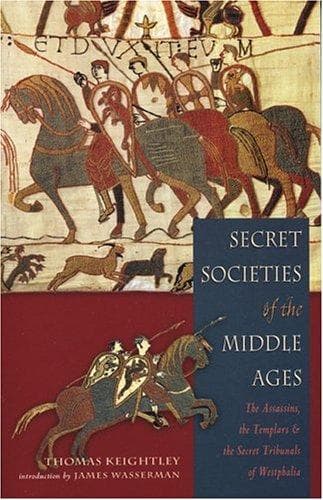
Secret Societies of the Middle AgesKeightley, Thomas
History
Secret Societies of the Middle Ages
Keightley, Thomas
Secret societies
We thus see that the proceedings in the Fehm-courts were strictly
consonant to justice, and even leaned to the side of mercy. But this was
not all: the right of appeal was also secured to the accused in case the
schöppen who consulted about the verdict did not agree, or that the
witnesses did not correspond in their evidence; or, finally, if the
verdict found was considered unjust or unsuitable; which last case
afforded a most ample field of appeal, for it must have been very rarely
that a sentence did not appear unjust or over-severe to the party who
was condemned. It was, however, necessary that the appeal should be made
on publication of the sentence, or at least before the court broke up.
The parties were allowed to retire for a few minutes, to consult with
their friends who had accompanied them. If they did not then say that
they would appeal, the sentence was declared absolute, and they were
forbidden, under heavy penalties, to oppose it in any other court. If
they did resolve to appeal, both parties were obliged to give security
_de lite prosequenda_. Should either party, being poor or a stranger, be
unable to give security, his oath was held to be sufficient, that, as
the law humanely and justly expresses it, "the stranger or the poor man
may be able to seek his right in the Holy Roman Empire as well as the
native or the rich man."
The appeal lay to the general chapter of the _Secret closed Tribunal of
the Imperial Chamber_, which usually, if not constantly, sat at
Dortmund; or it lay to the emperor, or king, as the supreme head of
these tribunals. In case of the monarch being initiated, he could
examine into the cause himself; otherwise he was obliged to commit the
inquiry to such of his councillors as were initiated, or to initiated
commissioners, and that only on Westphalian soil. Of this species of
appeal there are numerous instances. Finally, the appeal might be made
to the imperial lieutenant, who then inquired into the matter himself,
with the aid of some initiated schöppen, or brought it before the
general chapter of which he was president. There was no appeal to the
emperor from his sentence, or from that of the chapter.
Public-domain text, read in full here on John Shaqi.
Reviews
Reviews
No reviews yet
Be the first to share your thoughts on this work.
Elsewhere in the archive
Join the Discussion
Join the discussion
Sign in to leave a comment or review.
Sign InorCreate an account