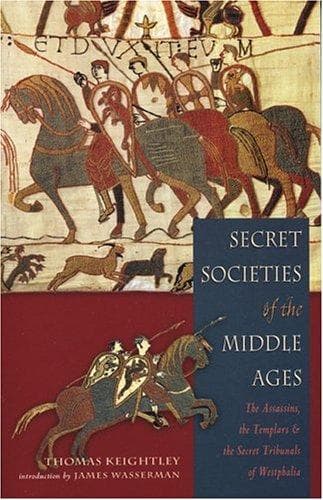
Secret Societies of the Middle AgesKeightley, Thomas
History
Secret Societies of the Middle Ages
Keightley, Thomas
Secret societies
The emperor's lieutenant, who was almost always the Archbishop of
Cologne, had the right of confirming such counts as were presented to
him by the Tribunal-lords, and of investing them with the powers of life
and death. He could also summon general chapters, and preside and
exercise the other imperial rights in them. He might decide, with the
aid of some schöppen, in cases of appeal to him, without bringing the
affair before the general chapter; and he had the power of making
schöppen at any tribunal in Westphalia, which proves that, like the
emperor, he had free access to them all. Hence it is clear that he also
must have been initiated.
The dignity and pre-eminence of the Archbishop of Cologne, when this
office had been conferred on him, caused a good deal of envy and
jealousy among the lords of Westphalia, who had been hitherto his
equals, and who considered themselves equally entitled to it with him.
They never let slip an occasion of showing their feelings, and they
always had their counts invested by the emperor, and not by the
archbishop; nay, there are not wanting instances of their having such
counts as he had invested confirmed and re-invested by the emperor.
There now remain only the Tribunal-Lords (_Stuhl-herrn_) to be
considered.
The Tribunal-lord was the lord of the district in which there was a
Fehm-tribunal. He might himself, if initiated, become the count of it,
having previously obtained the power of life and death from the emperor,
or his lieutenant; or, if he did not choose to do so, he might, as we
have already seen, present a count to be invested, for whose conduct he
was held responsible; and, if the count appointed by him misconducted
himself, the Stuhl-herr was liable to a forfeiture of his rights. He
was, in consequence, permitted to exercise a right of inspection over
the Fehm-courts in his territory; no schöppe could be made, no cause
brought into the court, not even a summons issued, without his
approbation. There even lay a kind of appeal to him from the sentence of
the count; and he could also, like the emperor, withdraw certain persons
and causes from his jurisdiction. But as his power did not extend beyond
his own territory, the count might refer those causes in which he
wished, but was prohibited, to proceed, to the courts in other
territories; he might also, if he apprehended opposition from the
Tribunal-lord, require him (if initiated) to be present at the
proceedings.
The Tribunal-lord, if uninitiated, could, like the emperor in the same
case, exercise these powers only by initiated deputies.
Public-domain text, read in full here on John Shaqi.
Reviews
Reviews
No reviews yet
Be the first to share your thoughts on this work.
Elsewhere in the archive
Join the Discussion
Join the discussion
Sign in to leave a comment or review.
Sign InorCreate an account