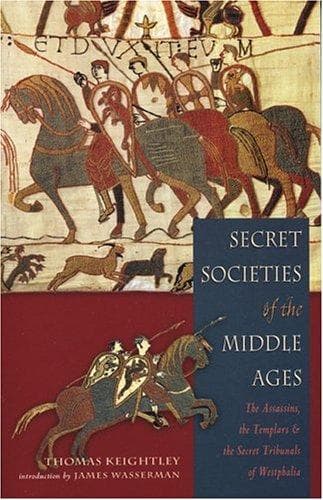
Secret Societies of the Middle AgesKeightley, Thomas
History
Secret Societies of the Middle Ages
Keightley, Thomas
Secret societies
There were similar courts, we are told, at places named Wölpe and
Rotenwald. Here the custom was for the Secret Judges, when they knew of
any one having committed an offence which fell within the
Fehm-jurisdiction, to give him a private friendly warning. To this end
they set, during the night, a mark on his door, and at drinking-parties
they managed to have the can sent past him. If these warnings took no
effect the court was held.
According to an ancient law-book, the Fehm-court at Brunswick was thus
regulated and holden. Certain of the most prudent and respectable
citizens, named _Fehmenotes_, had the secret duty of watching the
conduct of their fellow-citizens and giving information of it to the
council. Had so many offences been committed that it seemed time to hold
a Fehm-court, a day was appointed for that purpose. Some members of the
council from the different districts of the town met at midnight in St.
Martin's churchyard, and then called all the council together. All the
gates and entrances of the town were closed; all corners and bridges,
and the boats both above and below the town, were guarded. The
Fehm-clerk was then directed to begin his office, and the Fehmenotes
were desired to give their informations to him to be put into legal form
if the time should prove sufficient.
At daybreak it was notified to the citizens that the council had
resolved that the Fehm-court should be holden on this day, and they were
directed to repair to the market-place as soon as the tocsin sounded.
When the bell had tolled three times all who had assembled accompanied
the council, through the gate of St. Peter, out of the town to what was
called the Fehm-ditch. Here they separated; the council took their
station on the space between the ditch and the town-gate, the citizens
stood at the other side of the ditch. The Fehmenotes now mingled
themselves among the townsmen, inquired after such offences as were not
yet come to their knowledge, and communicated whatever information they
obtained, and also their former discoveries (if they had not had time to
do so in the night) to the clerk, to be put by him into proper form and
laid before the council.
The clerk having delivered his protocol to the council, they examined it
and ascertained which of the offences contained in it were to be brought
before a Fehm-court, and which not; for matters under the value of four
shillings did not belong to it. The council then handed the protocol
back to the clerk, who went with it to the Fehm-court, which now took
its seat in presence of a deputation of the council.
Public-domain text, read in full here on John Shaqi.
Reviews
Reviews
No reviews yet
Be the first to share your thoughts on this work.
Elsewhere in the archive
Join the Discussion
Join the discussion
Sign in to leave a comment or review.
Sign InorCreate an account