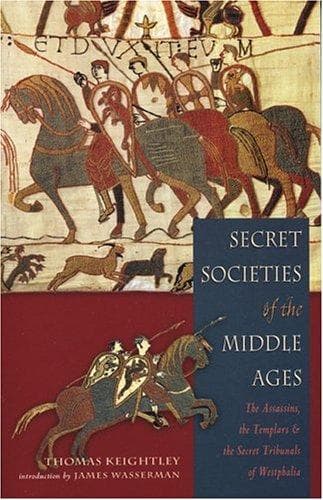
Secret Societies of the Middle AgesKeightley, Thomas
History
Secret Societies of the Middle Ages
Keightley, Thomas
Secret societies
The chief cause of the degeneracy of the Fehm-courts was the admission
of improper persons into the society. Originally, as we have seen, no
man was admitted to become a schöppe without producing satisfactory
evidence as to the correctness of his character; but now, in the case of
either count or schöppe, a sufficient sum of money availed to supersede
inquiry, and the consequence was that men of the most disgraceful
characters frequently presided at the tribunals and wielded the
formidable powers of the society. A writer in the reign of Sigismund
says, "that those who had gotten authority to hang men were hardly
deserving enough to keep pigs; that they were themselves well worthy of
the gallows if one cast a glance over their course of life; that they
left not unobserved the mote in their brother's eye, but overlooked the
beam in their own, &c." And it required no small courage in the writer
thus to express himself; for, according to his own testimony, people
then hardly ventured even to speak of the Secret Tribunals, so great was
the awe in which they were held.
The consequence was that justice was not to be had at any tribunal which
was presided over by corrupt judges, as they selected assessors, and
even by-standers, of the same character with themselves, and whatever
verdict they pleased was found. The tribunal-lord generally winked at
their proceedings, while the right of appeal to the emperor was treated
with little respect; for these monarchs had generally affairs of more
immediate importance to themselves to occupy their attention. The right
of exemption was also trampled on; sovereign princes were, as we have
seen, cited before the tribunals; so also were the Jews. Purely civil
matters were now maintained to belong to the Fehm-jurisdiction, and
parties in such cases were cited before the tribunals, and _forfehmed_
in case of disobedience. In short, the Fehm-jurisdiction was now become
a positive evil instead of being, as heretofore, a benefit to the
country.
Various attempts were doubtless made to reform the Fehm-law and
tribunals, such as the Arensberg reformation, the Osnaburgh regulation,
and others, but to little purpose. The system, in fact, was at variance
with the spirit which was now beginning to prevail, and could not be
brought to accord with it.
Before we proceed to the decline of the society, we will pause a moment
to consider the causes of the great reputation and influence which it
obtained and exercised during the period in which it flourished.
Public-domain text, read in full here on John Shaqi.
Reviews
Reviews
No reviews yet
Be the first to share your thoughts on this work.
Elsewhere in the archive
Join the Discussion
Join the discussion
Sign in to leave a comment or review.
Sign InorCreate an account