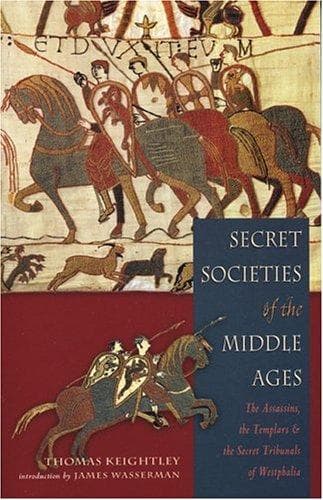
Secret Societies of the Middle AgesKeightley, Thomas
History
Secret Societies of the Middle Ages
Keightley, Thomas
Secret societies
Hassan Sabah clearly perceived that the plan of the society at Cairo was
defective as a mean of acquiring temporal power. The Dais might exert
themselves, and proselytes might be gained; but till possession was
obtained of some strongholds, and a mode of striking terror into princes
devised, nothing effectual could be achieved. He first, therefore, as we
have seen, made himself master of Alamoot and the other strong places,
and then added to the Dais and the Refeek another class, named Fedavee
(_Devoted_), whose task it was to yield implicit obedience to the
mandate of their chief, and, without inquiry or hesitation, plunge their
daggers into the bosom of whatever victim was pointed out to them, even
though their own lives should be the immediate sacrifice. The ordinary
dress of the Fedavee was (like that of all the sects opposed to the
house of Abbas) white; their caps, girdles, or boots, were red. Hence
they were named the White (_Mubeiyazah_), and the Red (_Muhammeré_[30]);
but they could with ease assume any guise, even that of the Christian
monk, to accomplish their murderous designs.
[Footnote 30: Ahmar, fem. Hamra, is _red_ in Arabic; hence the
celebrated Moorish palace at Granada was called Alhambra (_Al-Hamra_),
_i. e._ the Red.]
The gradations in the society were these. At the head of it stood Hassan
himself and his successors, with the title of Seydna, or Sidna[31] (_Our
Lord_), and Sheikh-al-Jebal (_Mountain Chief_), a name derived from that
of the territory which was the chief seat of the power of the society.
This last, owing to the ambiguity of the word _sheikh_ (which, like
_seigneur_ and _signore_, signifies either an _elder_ or _chief_), has
been ridiculously translated by the early European historians _Old Man
of the Mountain_. Under him were the Dai-'l-Kebir (_Great
Missionaries_), of which there were three, for the three provinces of
Jebal, Kuhistan, and Syria[32]. Then came the Dais, next the Refeek,
then the Fedavee, and lastly the Lazik, or aspirants.
[Footnote 31: Hence the Spanish _Cid_.]
[Footnote 32: Hammer, book ii.]
Hassan was perfectly aware that without the compressing power of
positive religion no society can well be held together. Whatever,
therefore, his private opinions may have been, he resolved to impose on
the bulk of his followers the most rigid obedience to the positive
precepts of Islam, and, as we have seen, actually put his own son to
death for a breach of one of them.
Public-domain text, read in full here on John Shaqi.
Reviews
Reviews
No reviews yet
Be the first to share your thoughts on this work.
Join the Discussion
Join the discussion
Sign in to leave a comment or review.
Sign InorCreate an account