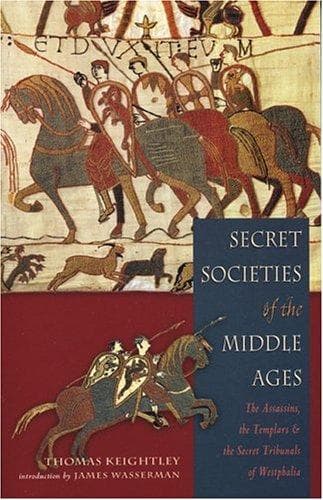
Secret Societies of the Middle AgesKeightley, Thomas
History
Secret Societies of the Middle Ages
Keightley, Thomas
Secret societies
Hassan is said to have rejected two of the degrees of the Ismaïlite
society at Cairo, and to have reduced them to seven, the original number
in the plan of Abdallah Maimoon, the first projector of this secret
society. Besides these seven degrees, through which the aspirants
gradually rose to knowledge, Hassan, in what Hammer terms the breviary
of the order, drew up seven regulations or rules for the conduct of the
teachers in his society. 1. The first of these, named Ashinai-Risk
(_Knowledge of duty_), inculcated the requisite knowledge of human
nature for selecting fit persons for admission. To this belonged the
proverbial expressions said to have been current among the Dais, similar
to those used by the ancient Pythagoreans, such as _Sow not on barren
ground_ (that is, Waste not your labour on incapable persons). _Speak
not in a house where there is a lamp_, (that is, Be silent in the
presence of a lawyer). 2. The second rule was called Teënis (_Gaining of
confidence_), and taught to win the candidates by flattering their
passions and inclinations. 3. The third, of which the name is not given,
taught to involve them in doubts and difficulties by pointing out the
absurdities of the Koran, and of positive religion. 4. When the aspirant
had gone thus far, the solemn oath of silence and obedience, and of
communicating his doubts to his teacher alone, was to be imposed on the
disciple; and then (5.) he was to be informed that the doctrines and
opinions of the society were those of the greatest men in church and
state. 6. The Tessees (_Confirmation_) directed to put the pupil again
through all he had learned, and to confirm him in it. And, (7.) finally,
the Teëvil (_Instruction in allegory_) gave the allegorical mode of
interpreting the Koran, and drawing whatever sense might suit their
purposes from its pages. Any one who had gone through this course of
instruction, and was thus become perfectly imbued with the spirit of the
society, was regarded as an accomplished Dai, and employed in the
important office of making proselytes and extending its influence.
Public-domain text, read in full here on John Shaqi.
Reviews
Reviews
No reviews yet
Be the first to share your thoughts on this work.
Elsewhere in the archive
Join the Discussion
Join the discussion
Sign in to leave a comment or review.
Sign InorCreate an account